Middle St. Johns River Basin Plan: SJRWMD Adopts Restoration Framework for Lake Jesup, Lake Monroe and the Wekiva River
With the St. Johns still holding high at Sanford and DeLand, regional water managers have adopted a long-term framework to guide restoration, water quality and flood protection across more than 2,000 square miles, including Lake Jesup, Lake Monroe, seven springs and the Wekiva River.
4 minute read
Environment & Water · St. Johns River
For anglers pushing onto Lake Jesup at first light, paddlers slipping down the Wekiva River on a Saturday, or residents watching the St. Johns creep toward docks at Sanford when the rains stack up, the river has never been an abstraction. It is the water at the end of the street — a working presence that rises, stalls and shapes daily life across Central Florida. Now the agency charged with managing that water has settled on a single, overarching blueprint for the river’s central reach, spanning more than 2,000 square miles of lakes, springs, creeks and wetlands from the Econlockhatchee River to north of Lake George.
The St. Johns River Water Management District announced on November 12 that its Governing Board, voting at its Tuesday meeting, had adopted the Middle St. Johns River Basin Plan, putting in place what the district describes as a long-term framework to guide restoration, water quality initiatives and flood protection across the region.
What the plan covers
The territory governed by the plan forms the working heart of the St. Johns in Central Florida. Stretching along a major reach of the river from the Econlockhatchee River to north of Lake George, the basin takes in four major lakes — Harney, Jesup, Monroe and George — along with two specially designated rivers, the Econlockhatchee and the Wekiva, and seven Outstanding Florida Springs that the district’s release does not name individually. Together, according to the district, those waters sustain wildlife habitat, recreation and the region’s water resources. Readers familiar with the Wekiva from its headwaters can follow related reporting on our Wekiwa Springs hub.
What the plan does
On paper, the plan sets three core priorities for the basin: improving water quality in its lakes and waterways, protecting its Outstanding Florida Springs, and strengthening flood protection along its lakes and rivers. That third goal arrives at a moment when the river itself remains stubbornly elevated. On November 16, the National Weather Service in Melbourne reported that water levels on the St. Johns at Sanford and DeLand were forecast to hold nearly steady in Action Stage for several weeks — a lingering high-water stretch tracked by our Weather desk in its St. Johns River flood coverage.
“This plan provides a clear path forward for protecting the Middle St. Johns River Basin’s valuable water resources and natural systems,” said Cammie Dewey, the district’s strategic planning basin coordinator. Dewey pointed to strong partnerships and science-based decision-making as the foundation allowing the district to keep improving water quality, safeguarding the springs and bolstering flood protection while preserving the basin’s natural resources.
How it was made, and what comes next
According to the district, the plan took shape in coordination with local governments, environmental stakeholders and state agencies, and went through a public comment period before reaching the Governing Board so that stakeholder feedback could refine and strengthen the final document.
The vote marks the third of four strategic basin plans the district expects to bring before its board. Two others — the Indian River Lagoon/Upper St. Johns River Plan and the Ocklawaha River Basin Plan — won approval earlier this year, leaving the Lower St. Johns River Strategic Basin Plan to be presented at a future meeting. Still, adopting a framework is only a threshold step: on its own, the plan neither funds nor schedules individual projects. Instead, it establishes the priorities under which the district’s restoration, water-quality and flood-protection work in the middle basin will now be organized, leaving the concrete, project-level choices ahead — decisions this desk will continue to follow.
For Central Florida readers, the board’s vote is the district’s second consequential water decision within a month. Earlier reporting details how the district lifted Lake County’s extreme water shortage order while keeping once-a-week winter watering, while our springs coverage tracks manatee season at Blue Spring, where the spring run has closed to swimming for the winter. Full coverage from the beat can be found in the Environment archive.
Sources & notes
Every fact in this article comes from the St. Johns River Water Management District’s own release, “District approves updated restoration plan for Middle St. Johns River Basin,” published November 12, 2026, at sjrwmd.com and checked November 17, 2026: the Governing Board’s vote at its Tuesday meeting, the plan’s purpose and priorities, the basin’s size (more than 2,000 square miles), its reach (Econlockhatchee River to north of Lake George), the four major lakes named (Harney, Jesup, Monroe, George), the seven Outstanding Florida Springs (not individually named in the release, and not named here), the two designated rivers (Econlockhatchee and Wekiva), the coordination and public-comment history, the Dewey quotation, and the plan’s position as the third of four basin plans. The Action Stage line is from the National Weather Service, Melbourne, hydrologic statement issued 8:08 p.m. EST, November 16, 2026.
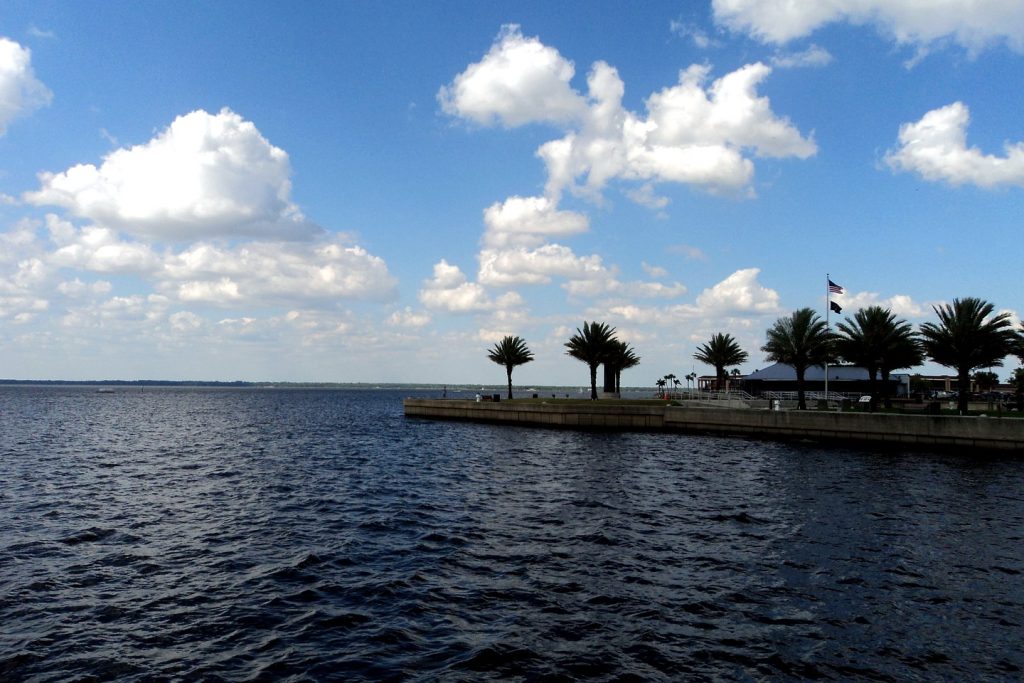
Photo: Lake Monroe at Sanford, on the St. Johns River in Seminole County — one of the four major lakes named in the adopted basin plan. Photo by Gabriel Vanslette, CC BY, via Wikimedia Commons; the paper’s photo grade applied. Featured image reused from the Citizen’s St. Johns River flood coverage.
Orlando Citizen by email
The weekly edition, in your inbox
One email, every Saturday: the week’s edition of Orlando Citizen — the week’s stories, rankings and winners, gathered in one place. Free, and you can unsubscribe at any time.
Related Stories
Editor’s Picks
Spotted an error? Tell us — corrections · How we rank
