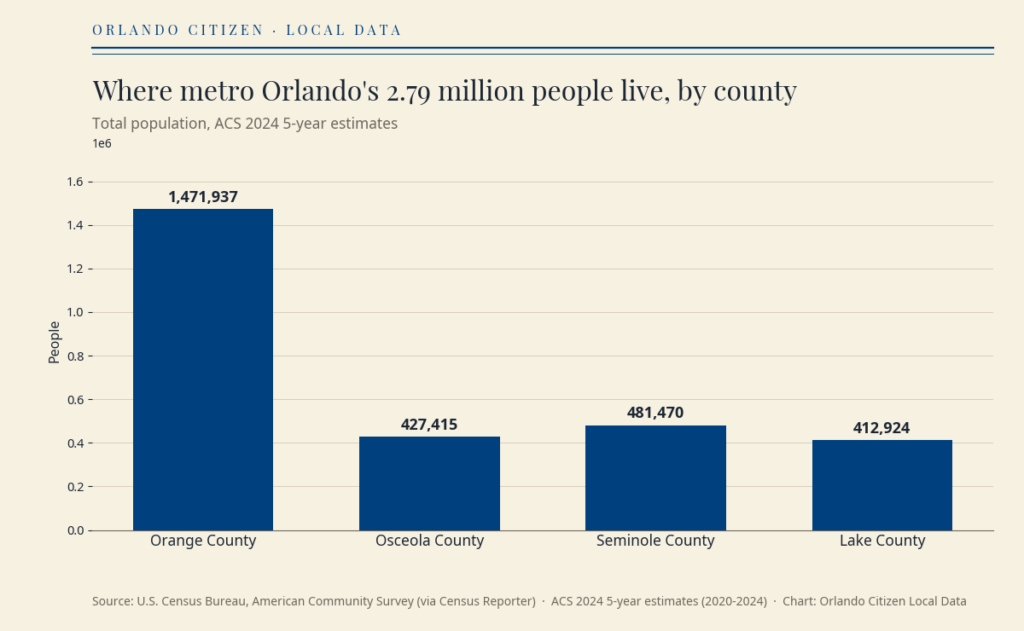
Metro Orlando counts 2.79 million people — and Osceola is growing nearly three times as fast as Orange
The four-county metro counted 2,793,746 people in the Census Bureau's 2020-2024 survey, while the Bureau's estimates series puts growth at 9.7% since 2020, led by Osceola County.
2 minute read
The headline numbers
- Total population (ACS 2024 5-year): 2,793,746
- Census Bureau population estimate, July 1 2024 (four counties combined): 2,940,513
- Growth in the estimates series, 2020 to 2024: 9.7% (259,920 people)
- Median age: 38.5 years
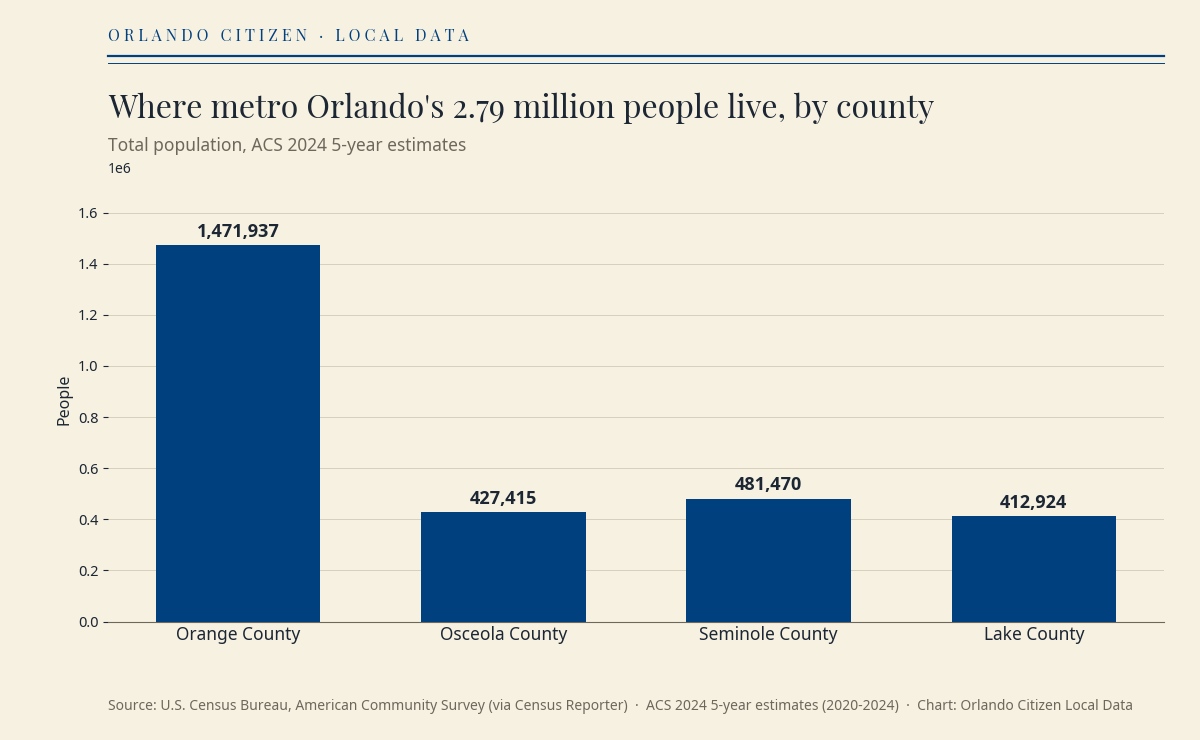
- Largest county: Orange, with 1,471,937 people. Fastest-growing: Osceola, up 19.7% in the estimates.
Metro Orlando — the four counties of Orange, Osceola, Seminole and Lake — counted 2,793,746 people in the Census Bureau’s American Community Survey for 2020-2024. The Bureau’s separate population estimates program, which counts differently and more recently, puts the four counties at 2,940,513 as of July 1, 2024, up 259,920 on the same date in 2020. The two series are not interchangeable, and this desk does not splice them: the survey gives the detailed picture, the estimates give the growth line.
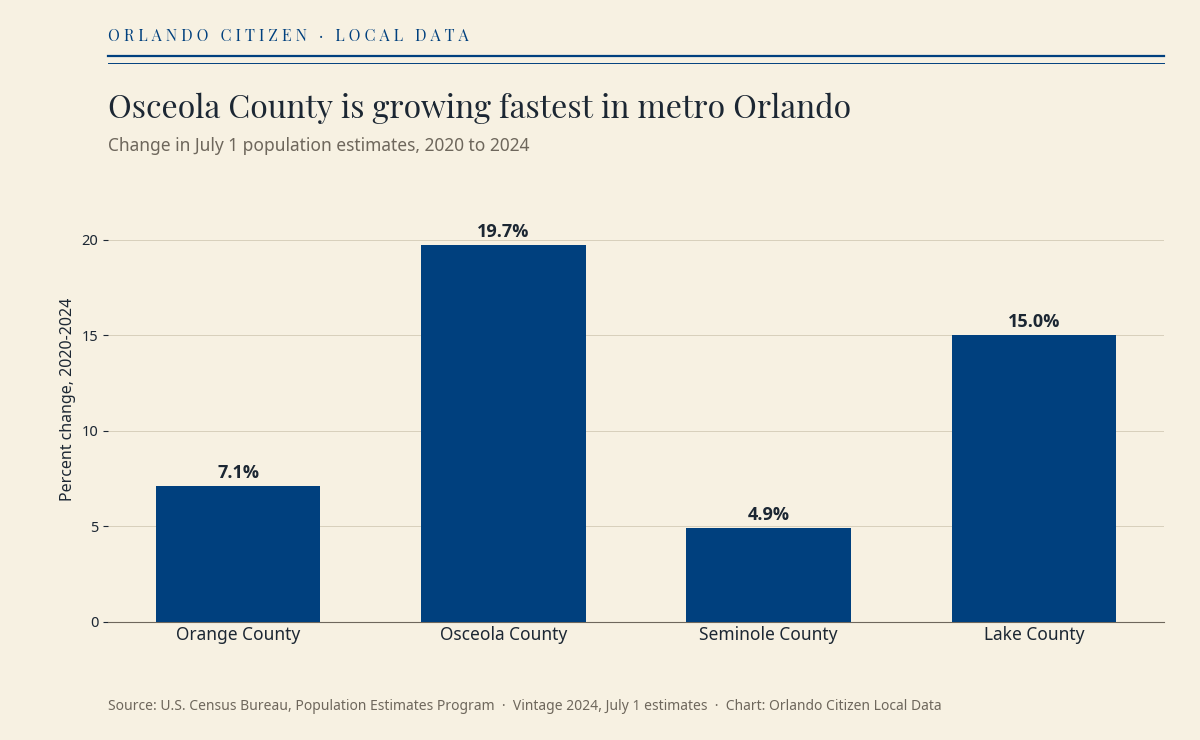
That growth is not spread evenly. Osceola County’s estimate rose 19.7% in four years and Lake County’s rose 15.0%, while Seminole County — the metro’s most built-out county — rose 4.9%. Orange County holds just over half the metro’s people and grew 7.1%.
The numbers
| County | Population (ACS 2024 5-year) | Growth 2020-2024 (Census estimates) |
|---|---|---|
| Orange County | 1,471,937 | 7.1% |
| Osceola County | 427,415 | 19.7% |
| Seminole County | 481,470 | 4.9% |
| Lake County | 412,924 | 15.0% |
The survey figures are estimates drawn from five years of sampling, not a head count; county-level margins are small, but they are still estimates. The estimates series is a model built on the 2020 census base, births, deaths and migration records. Where the two disagree, both are printed and labelled.
Keep reading
- Orange County’s population in full
- Osceola County’s population in full
- Seminole County’s population in full
- Lake County’s population in full
- Who earns what in metro Orlando
- The Local Data hub
Sources & notes
Key facts in this article were checked against:
- U.S. Census Bureau — Census Reporter profile, Orlando-Kissimmee-Sanford metro area — confirms the survey population and median age for the metro area
- U.S. Census Bureau — Population Estimates Program, Vintage 2024 county file — confirms the July 1 2020 and 2024 population estimates summed here for the four metro counties
Data note: U.S. Census Bureau, American Community Survey, tables B01003 (total population) and B01002 (median age), ACS 2024 5-year release (2020-2024), geography: Orlando-Kissimmee-Sanford, FL Metro Area (31000US36740), accessed via the Census Reporter data API. Retrieved 2026-11-15.
Data note: U.S. Census Bureau, Population Estimates Program, Vintage 2024 county/place estimates file (https://www2.census.gov/programs-surveys/popest/datasets/2020-2024/counties/totals/co-est2024-alldata.csv), July 1 estimates for 2020 and 2024 — a single estimates series, not mixed with the ACS survey figures. Retrieved 2026-11-15.
Orlando Citizen by email
The weekly edition, in your inbox
One email, every Saturday: the week’s edition of Orlando Citizen — the week’s stories, rankings and winners, gathered in one place. Free, and you can unsubscribe at any time.
Related Stories
Editor’s Picks
Spotted an error? Tell us — corrections · How we rank