Lagarde Will Leave the ECB Early, in the Middle of a French Election. The Succession Race Is Open.
Seeking "freedom to engage on matters that are not monetary policy matters," Christine Lagarde will step down as president of the European Central Bank on Feb. 7, 2027, eight months early — placing the choice of her successor in the middle of France's presidential campaign.
3 minute read
PARIS — At 70, having led the European Central Bank since November 2019, Christine Lagarde used an Oct. 29 meeting meant to be about interest rates to announce that she is leaving early. She informed the Governing Council that she will step down as the bank’s president on Feb. 7, 2027 — eight months before her term is due to expire in October of that year — because, in the words Le Monde carried from her announcement, she wants “freedom to engage on matters that are not monetary policy matters.”
The explanation has done nothing to quiet speculation about what Ms. Lagarde intends to do next, and it has wholly redirected attention from the bank’s rate path to its succession. Markets, which had widely expected the rate hold she announced the same day, barely moved on the decision. What reignited the argument over who runs the eurozone’s central bank next was the departure itself — and a calendar that, as Le Monde noted, lands her exit in the middle of the French presidential election campaign.
How a successor is chosen — and why France looms
Choosing an ECB president is, by design, a political appointment dressed in technocratic clothes, and its timing is rarely innocent. The post is filled by the European Council — the eurozone’s heads of government — after consultation with the European Parliament and the bank’s own Governing Council. Because the vacancy opens in February 2027, the choice will be negotiated in the opening months of a year in which France, the eurozone’s second-largest economy and the co-author of the single currency, chooses a new president in the spring. Emmanuel Macron, the outgoing French president, will still be in the Élysée when the succession is decided, even as the campaign to replace him runs at full volume around it.
For now, no successor has been named. What is clear is structural: the appointment requires the assent of governments already mid-argument about deficits, energy and the bank’s mandate. Whoever takes the chair in February will inherit a council actively debating rate rises — including, possibly, at the Dec. 17 meeting, one of the last Ms. Lagarde is scheduled to chair. That successor will also inherit the question her tenure leaves open: how an independent central bank behaves when the fiscal policy of its largest members is set by parliaments that cannot pass budgets.
The tenure
When Ms. Lagarde moved to Frankfurt from the International Monetary Fund in 2019, she took the helm as a lawyer and former French finance minister — the first woman to lead the ECB, the first of its presidents without a career inside a central bank and a political manager appointed to run a technical institution. She leaves having steered the bank through a pandemic, an inflation surge that took eurozone prices into double digits, the fastest tightening cycle in the bank’s history, the cuts that followed and now a second, energy-driven rise in inflation that has the council debating increases again. Her final scheduled act of consequence is likely to be the Dec. 17 decision, at which a quarter-point rise is the market’s expectation. After Feb. 7, the freedom she asked for is hers. For the eurozone, what follows is more complicated.
More of the desk’s European coverage, including the October rate decision this announcement overshadowed, is in the Global News section.
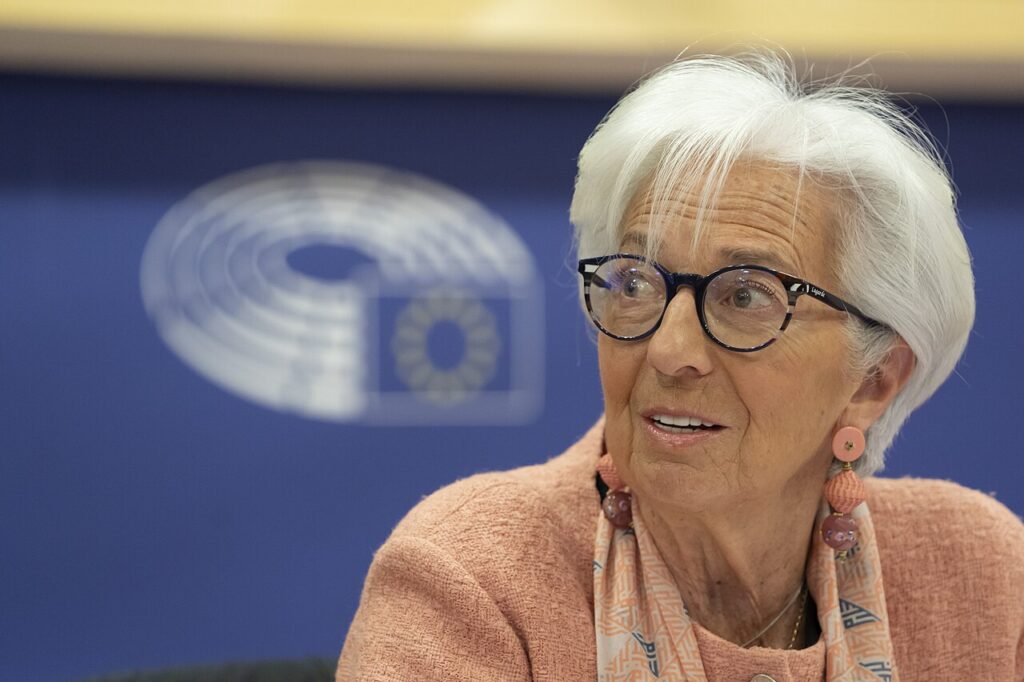
Featured image: Christine Lagarde at the European Parliament, March 2025. Photo: Philippe Buissin / European Parliament, CC BY 4.0, via Wikimedia Commons.
Sources & notes
- The resignation (effective Feb. 7, 2027, some eight months before the October 2027 term end), its announcement to the Governing Council on Oct. 29, 2026, and the quotation of her reason: Le Monde, Oct. 30, 2026, and the ECB’s announcement as reported the same day by FXStreet.
- The observation that the departure date falls in the middle of the French presidential election campaign: Le Monde, Oct. 30, 2026.
- The succession speculation reignited by the announcement, and the market’s muted reaction to the rate hold: Le Monde and EBC Financial Group reporting, Oct. 29–30, 2026.
Orlando Citizen by email
The weekly edition, in your inbox
One email, every Saturday: the week’s edition of Orlando Citizen — the week’s stories, rankings and winners, gathered in one place. Free, and you can unsubscribe at any time.
Related Stories



Editor’s Picks
Spotted an error? Tell us — corrections · How we rank