Paris Unrest Enters Its Third Month: Bans in Force, Police in the Streets and a Saturday to Watch
What began in September with students blockading their schools has widened into France's defining autumn confrontation — marked by five consecutive Saturdays of marches, a night of rioting in the capital, protest bans around Paris schools and universities and, on Wednesday, police officers marching on their own ministry — leaving visitors to a calm central city to navigate a crowded calendar ahead.
5 minute read
PARIS — On Wednesday, the demonstrators marching on France’s Interior Ministry were the police officers that it commands — the latest turn in an autumn of unrest that began in September with students blockading their schools and has come to define French public life. Across five consecutive Saturdays of demonstrations, one night of serious rioting in the capital and protest bans now in force around Paris schools and universities, a movement born in the schools has steadily widened, leaving anyone travelling to Paris in the coming days to weigh where the unrest stands and what is scheduled next.
How it began
The confrontation started in mid-September at a high school in Créteil, southeast of Paris, where students put up the first blockades over what they described as deteriorating conditions: dilapidated buildings, teacher shortages and a higher-education admissions system they regard as unfair, according to wire reporting on the movement’s origins. Cost-of-living groups soon joined them, followed by the unions, turning Saturday marches into a weekly fixture. The violence peaked on Saturday, Oct. 17 — the movement’s worst night — when rioting across several Paris neighborhoods left shops looted, windows smashed and fires burning.
Still, the crowds kept returning. On one recent Saturday, the Interior Ministry counted 410,000 demonstrators nationwide, including 110,000 in Paris, while the CGT union confederation put both figures at nearly double the official totals. As night fell at the end of that march, police fired tear gas and water cannon to disperse the crowd, and authorities said some 500 “rioters” had clashed with law enforcement. Nearly 1,000 people had been arrested nationwide, the Interior Minister, Laurent Nuñez, said, with more than 70,000 police officers and gendarmes deployed to prevent a repeat of the previous weekend’s violence.
The government’s answer so far
Caught between street violence and the movement’s economic grievances, the government has answered with both bans and a wage concession. President Emmanuel Macron blamed the October riots on what he called “seditious acts” by ultra-left groups, and the authorities have since banned planned demonstrations in parts of Paris, Lyon, Lille and Grenoble. In the unrest’s earlier phase, after riots broke out in several areas, the Justice Minister, Gérald Darmanin, said at least 2,700 people had been taken into custody. Yet officials have also moved on the movement’s economic grievances, having already raised the minimum wage in response to the earlier demonstrations, according to wire reporting of the protests’ course.
In Paris, the newest restriction is pointedly specific, circling back to the schools and universities where the movement took root. After weeks of blockades at educational sites, the Paris police prefect, Patrice Faure, has banned protests near 10 secondary schools and five universities from Nov. 16 to Nov. 20. Announcing the measure, Mr. Faure said the blockades had damaged public property, led to violence against members of the educational community and produced clashes with law enforcement; since the protests began, he said, 1,548 people had been arrested in Paris.
This week
Neither the restrictions nor the minimum-wage increase has cleared the streets. On Tuesday, the movement’s latest national day of action drew 146,000 people nationwide, including 28,000 in Paris along a route from Place de la Nation to Place d’Italie, according to the Interior Ministry; the CGT put the national turnout at more than 500,000. By Wednesday, no major demonstration was confirmed in central Paris, yet protest has hardly paused: the day’s march belonged to the police themselves, who demonstrated over their risk allowance at the call of the Alliance Police Nationale union, a development this desk reports separately.
The calendar ahead remains crowded. On Thursday, pensioners are scheduled to march from Gare Montparnasse to Les Invalides beginning at 11 a.m., while a separate protest is planned outside the Senate, near the Luxembourg Gardens, and the Métro’s Line 7bis closes from 10 p.m. for maintenance work, according to the RATP. Friday brings an international student strike day. Attention then shifts to Saturday, when a Yellow Vest gathering has been announced near Place de la Nation with a proposed march at 2 p.m., though the route and police approval have not been confirmed.
What it means for travellers
For Central Florida readers with Paris on an itinerary — the city is a standard European pairing with an Orlando trip — the practical reality on the ground is narrower than the headlines suggest. Central Paris was calm on Wednesday, and museums, restaurants, shops and attractions have generally remained open as usual, even during demonstrations. Because the current bans are drawn around named schools and universities rather than tourist districts, the weekend risk is concentrated on announced march routes on Saturday afternoons. The working rules are the ones this desk applies to its own travel: check the RATP’s traffic page on the morning of any Saturday march, keep clear of the announced routes, and treat unconfirmed gathering calls — Saturday’s included — as unconfirmed until the Préfecture de police says otherwise. Readers can find this desk’s travellers file on Europe’s entry rules, including why there is still no ETIAS to apply for, in the Global News section.
What is not in doubt is the political frame. France is roughly six months from a presidential election, its government has been unable to pass a budget — on Nov. 4, the National Assembly rejected the 2027 finance bill, 458 to 0 — and the street has become the arena where the argument over wages, schools and the cost of living is being settled week by week. While the unrest remains a live story, this desk will file on it daily.
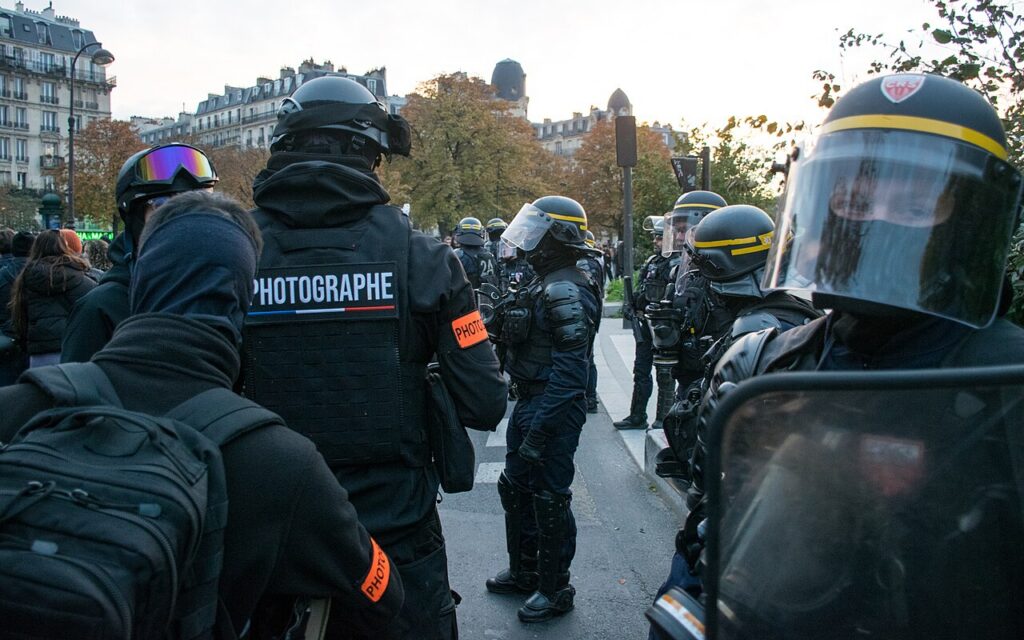
Featured image: A demonstration in Paris during the autumn protest movement, Nov. 5, 2026. Photo: Jules*, CC BY-SA 4.0, via Wikimedia Commons.
Sources & notes
- Interior Ministry turnout figures for Tuesday, Nov. 17 (146,000 nationwide; 28,000 in Paris) and the CGT counter-figure (more than 500,000), and the government’s minimum-wage increase in response to earlier demonstrations: Bernama wire report, Nov. 18, 2026.
- Préfecture de police protest ban near 10 secondary schools and five universities, Nov. 16–20, and Police Prefect Patrice Faure’s statement that 1,548 people had been arrested in Paris since the protests began: The Fact Wire, Nov. 16, 2026, updated Nov. 18, 2026.
- The Saturday turnout (410,000 nationwide, 110,000 in Paris per the Interior Ministry; CGT nearly double), the tear-gas and water-cannon dispersal, some 500 “rioters,” nearly 1,000 arrests and the deployment of more than 70,000 officers: Al Jazeera’s reporting of the Saturday marches and the Interior Ministry’s statements, October 2026.
- President Macron’s “seditious acts” charge, the demonstration bans in Paris, Lyon, Lille and Grenoble, and Justice Minister Gérald Darmanin’s figure of at least 2,700 taken into custody: Al Jazeera, Oct. 22, 2026.
- The Oct. 17 riots (looting, smashed windows, fires), the movement’s September origins at Créteil, Wednesday’s situation in central Paris, and the announced schedule for Nov. 19–21 (pensioners’ march, Senate protest, Line 7bis closure, possible Yellow Vest gathering): the Paris protest tracker maintained by Paris à la Carte, checked Nov. 18, 2026, citing FSU, Attac and RATP notices. Announced gatherings are reported as announced; Saturday’s Yellow Vest call is unconfirmed.
Turnout figures are given as their publishers state them: the Interior Ministry’s counts and the CGT’s are both carried, because the two have differed widely throughout the movement.
Orlando Citizen by email
The weekly edition, in your inbox
One email, every Saturday: the week’s edition of Orlando Citizen — the week’s stories, rankings and winners, gathered in one place. Free, and you can unsubscribe at any time.
Related Stories

Editor’s Picks
Spotted an error? Tell us — corrections · How we rank