The Bank of England Raised Rates for the First Time in Three Years. Nobody Voted to Hold.
Even the Monetary Policy Committee's most dovish members backed an 8-to-1 vote on Nov. 5 to lift Bank Rate to 4 percent — while the lone dissenter, Catherine L Mann, held out for 4.25 percent — upending assumptions for British borrowers ahead of December's decision.
3 minute read
PARIS — Going into November, analysts watching the Bank of England thought they knew where resistance to higher borrowing costs would come from. Swati Dhingra and Alan Taylor, the Monetary Policy Committee’s most dovish external members, were expected to resist an increase and vote to stay put, producing a 7-to-2 split. Instead, on Nov. 5, both voted to raise — joining an 8-to-1 majority that lifted the benchmark Bank Rate by a quarter point, to 4 percent, without a single vote to hold.
Even the lone dissenter pushed harder in the same direction: Catherine L Mann wanted half a point, to 4.25 percent. The result wrong-footed markets and delivered the first increase in Bank Rate in more than three years, since August 2023. In September, the committee had held at 3.75 percent by 6 votes to 3, when only Ms. Mann, Megan Greene and the Bank’s chief economist, Huw Pill, were already voting for a rise.
The energy argument
Behind the shift lies a Middle East conflict now in its ninth month, which the Bank’s November Monetary Policy Report describes as driving global energy prices still higher from an already high level. The direct effects of higher energy prices on bills are clear and will keep feeding through, the Bank said, while evidence of knock-on effects on other prices and wages remains limited. Yet it is those knock-on effects that policymakers are determined to pre-empt. On the Bank’s new forecast, inflation rises from 3.5 percent in September to about 5 percent by the middle of 2027; in the financial-market pricing the Bank used for its report, Bank Rate stood near 4.9 percent by the end of 2027.
Threadneedle Street is tightening into an unforgiving fiscal position that leaves it very little company. Eight days before the rate decision, Chancellor John Healey delivered his first Autumn Budget, scored by the Office for Budget Responsibility against a worsening backdrop: debt interest £14 billion a year higher than forecast in March, public debt heading toward 97 percent of gross domestic product, and the Chancellor’s headroom against his fiscal rules down to £15 billion in 2029-30, from £23.6 billion left in the spring. In the Budget’s aftermath, the 10-year gilt yield opened around 5.35 percent.
What would stop them
The committee insists policy is not on a pre-set path, and the days since Nov. 5 have kept both directions of the argument alive. On Nov. 11, Ms. Greene argued publicly that further proactive tightening was warranted to head off persistent wage and price pressures. Pulling the other way is a housing market already cooling under the rate it has, with the Royal Institution of Chartered Surveyors’ October house-price balance at minus 36 — alongside Wednesday’s October inflation print of 3.6 percent, the first since the decision, which landed below the Bank’s own projection.
For British borrowers, the era in which the Bank’s next move was assumed to be a cut is over. The November inflation print arrives on Dec. 16, one day before the committee decides again on Dec. 17, with new forecasts following on Feb. 4. November settled whether this committee is hawkish; the question hanging over December is whether a single quarter-point was a warning shot or the first of a sequence. More of the desk’s United Kingdom coverage is in the Global News section.
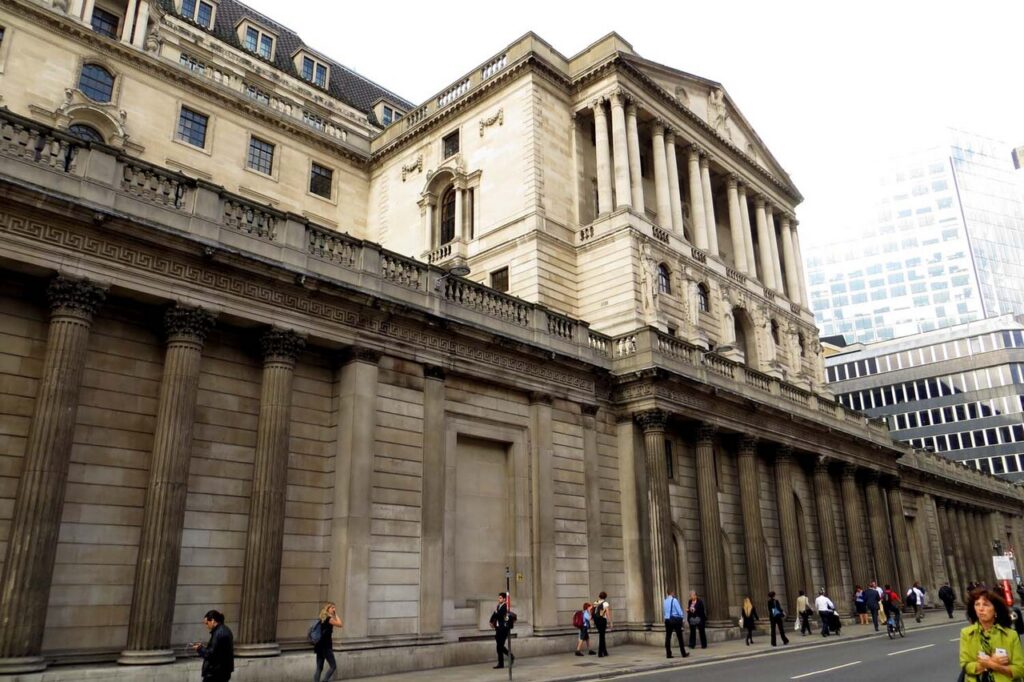
Featured image: The Bank of England on Threadneedle Street, London. Photo: Steve Daniels, CC BY-SA 2.0, via Wikimedia Commons.
Sources & notes
- The Nov. 5 decision (Bank Rate to 4 percent; the vote of 8 to 1; Ms. Mann’s preference for 4.25 percent; the membership of the majority), the September hold of 6 to 3, and the next decision date of Dec. 17: Bank of England, “Monetary Policy Summary and minutes, November 2026,” Nov. 5, 2026, and the Bank’s Bank Rate record.
- The forecast (inflation to about 5 percent by mid-2027), the energy and Middle East analysis, and the market path pricing Bank Rate near 4.9 percent at the end of 2027: Bank of England, Monetary Policy Report, November 2026.
- The expected 7-to-2 split and the pre-meeting assumptions about Ms. Dhingra and Mr. Taylor: market reporting of the minutes, Nov. 9, 2026.
- The Budget figures (debt interest £14 billion a year above the March forecast; debt toward 97 percent of G.D.P.; headroom of £15 billion in 2029-30, down from £23.6 billion; the gilt yield near 5.35 percent): Office for Budget Responsibility forecasts as assessed in Newcastle University Business School’s commentary on the Autumn Budget of Oct. 28, 2026.
- Ms. Greene’s remarks of Nov. 11 and the RICS October house-price balance of minus 36: FactRail economic report, Nov. 14, 2026.
Orlando Citizen by email
The weekly edition, in your inbox
One email, every Saturday: the week’s edition of Orlando Citizen — the week’s stories, rankings and winners, gathered in one place. Free, and you can unsubscribe at any time.
Related Stories



Editor’s Picks
Spotted an error? Tell us — corrections · How we rank