Longwood Kept Its 19th Century. Here’s How to Walk It.
Arrive by SunRail, start at the clock tower, and walk a National Register district of 1880s cottages, a moved Queen Anne mansion and a church from about 1880 — Longwood's historic core in one unhurried hour.
3 minute read
Most Seminole County suburbs were built around a highway interchange. Longwood was built around a railroad, a hotel and a cluster of winter cottages — and, unusually for Central Florida, it kept them. The Longwood Historic District, added to the National Register of Historic Places in 1990, protects the town’s original core around Church Avenue and Warren Avenue, just west of Ronald Reagan Boulevard (County Road 427). It is the rare Orlando-area history lesson you can do entirely on foot, in about an hour, starting from a train platform. Our full Longwood guide covers the wider town; this is the walk itself.
Arrive the Old Way: By Train
Longwood exists because of rail. The community began as a junction of lines running between Sanford and Orlando in the early 1880s, and passenger service returned on May 1, 2014, when the Longwood SunRail station opened at 149 East Church Avenue, on the edge of the district. The station’s canopies break from SunRail’s standard design — brown gabled roofs with cupolas and faux dormers, styled to sit comfortably beside the old buildings. Step off the train and you are a few minutes’ walk from streets that have changed remarkably little in a century. It makes Longwood one of the easiest historic districts in Florida to visit without a car.
Start at the Clock Tower
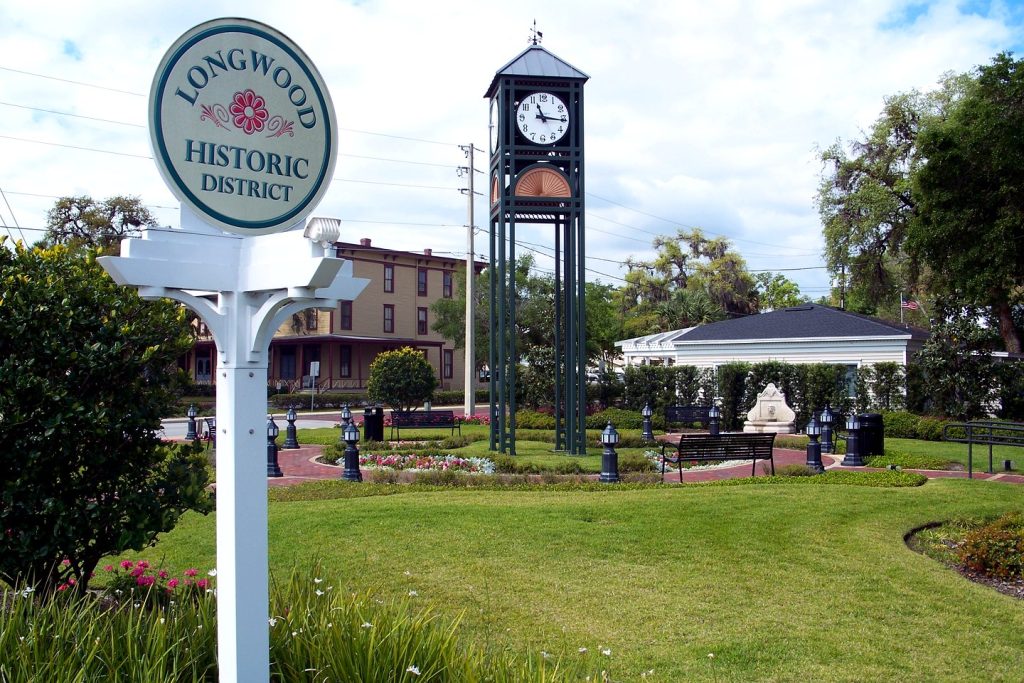
Begin where the town introduces itself: the Historic District sign and clock tower on the green at Church Avenue, with the old Longwood Hotel — now the Longwood Village Inn, an office building on the National Register since the 1980s — standing behind it. The district that unfolds from here is compact and primarily residential, a grid of oak-shaded streets settled between about 1880 and 1926, with more than three dozen contributing historic buildings among its churches, cottages and small commercial blocks.
The Houses That Carry the Story
Two of the district’s most important houses were not built here at all. The Bradlee-McIntyre House, an 1885 Queen Anne winter cottage at 130 West Warren Avenue, was moved from Altamonte Springs in 1973 to save it from demolition, and it now anchors the district as a museum. Its travelling companion, the Inside-Outside House at 141 West Church Avenue, is stranger still: a prefabricated house dating to about 1873, shipped from New England to Sanford and hauled inland by wagon, named for the exposed wooden framing visible on some of its exterior walls.
Walk west on Church Avenue and you pass Christ Episcopal Church, dating to about 1880 and generally counted the district’s earliest surviving structure, its white board-and-batten tower still the street’s landmark. Nearby stand the Clouser Cottage from 1881 and a run of 1880s cottages along Warren Avenue — seven of the district’s contributing houses line that one street. The Longwood Historic Society’s self-guided walking tour strings the stops together with the stories attached to each address, and it is worth pulling up on your phone before you set out.
End on the Green at Reiter Park
The walk’s natural finish is Reiter Park, the six-acre park beside the district that the city rebuilt and reopened in 2018 with an amphitheater, pavilions, a splash pad and a fishing pier. On Saturdays the park hosts the city’s farmers market, and through the year it fills with concerts and festivals — the modern front lawn for a 19th-century town. If the timing works, plan the walk for a market morning and let the district’s past and present share the same hour.
Before You Go
The district rewards slowness: read the plaques, look for the scroll-sawn porch brackets and polygonal turrets that mark the Queen Anne cottages, and remember that most of these are private homes — admire from the sidewalk. Afterwards, plot the rest of the town, from Big Tree Park’s ancient cypresses to the Wekiva River, on our Orlando Top Spots Map. Longwood’s lesson is a simple one: a suburb that saves its old buildings ends up with something no new development can fake — a there, there.
Photo: Ebyabe, CC BY 2.5, via Wikimedia Commons.
Orlando Citizen by email
The weekly edition, in your inbox
One email, every Saturday: the week’s edition of Orlando Citizen — the week’s stories, rankings and winners, gathered in one place. Free, and you can unsubscribe at any time.
Related Stories


Editor’s Picks
Spotted an error? Tell us — corrections · How we rank