Disney Parks Earnings: Record $39.6 Billion Year as Walt Disney World Leads Disney’s Growth
Walt Disney World’s craft maintenance unions are voting on a revised wage offer after Disney’s parks, resorts and cruise business reported a record $39.6 billion in annual revenue.
5 minute read
Housekeepers, bus drivers, line cooks and maintenance mechanics are among the tens of thousands of Central Floridians who earn their living at Disney and keep the world’s most visited resort running. On Tuesday morning, a letter to shareholders set out how well the parks had done. For the people who work there, it left open a question about their own pay.
“Consumers around the world, faced with endless options, chose Disney,” Chief Executive Josh D’Amaro and Chief Financial Officer Hugh Johnston wrote in the Walt Disney Company’s fiscal 2026 earnings release. Disney Experiences, the business that includes the theme parks, resorts and cruise line, had its strongest year on record. Revenue rose 9% to $39.6 billion in the fiscal year ended Oct. 3, 2026, and operating income rose 12% to $11.2 billion. Disney said both measures set records for the fourth quarter and the full year, even after accounting for an extra week on the fiscal calendar.
The release gives no separate revenue or attendance figures for Walt Disney World. A similar limitation applies to SeaWorld’s parent company, which reports only company-wide results. Disney reports results for the domestic parks business, which Walt Disney World anchors and which also includes Disneyland. The company described what drove growth at the Florida resort in its letter.
What Disney says about Walt Disney World
“It was another strong quarter for our largest site, Walt Disney World,” the shareholder letter says, “where a steady run of new offerings, our IP, and a commercial strategy focused on domestic guests drove strong growth, aided by favorable comparisons to the prior-year quarter.”
In the fourth quarter, Domestic Parks & Experiences revenue rose 19% to $6.97 billion, and domestic operating income rose 36% to $1.25 billion. Attendance at the domestic parks increased 11%, and guests spent 4% more per person than a year earlier. Across the Experiences segment, quarterly revenue rose 15% to $10.1 billion and operating income rose 20% to $2.25 billion. Disney counted 11% more guests globally in the quarter, and the full-year count rose 5% to an all-time record.
The extra week, stated plainly
Fiscal 2026 lasted 53 weeks, with the extra week falling entirely in the fourth quarter. Disney estimates that the 53rd week accounted for about 7 percentage points of the quarter’s 15% Experiences revenue growth and about 10 points of its 20% operating-income growth. With that week excluded, the increase in global guests was 4% and the increase in domestic park attendance was 3%. The growth rates were lower, and Disney said the records still stood.
One weakness persisted. Disney said it “continued to see headwinds from lower international attendance at our domestic parks in the quarter,” although the drag eased from the third quarter. Visit Orlando’s data and SeaWorld’s results have shown similar weakness in international visits along the corridor this year. At Walt Disney World, Disney’s strategy has focused on domestic guests.
Where the resident angle sharpens: labor
How much of a record year reaches the people who staff the parks remains an open question. Experiences operating labor cost $2.59 billion in the fourth quarter. Beyond the extra week, Disney attributed the increase to inflation and new guest offerings. The company also said it now expects an efficiency program it described last quarter to deliver about $3 billion in annual run-rate operating-expense savings by fiscal 2029. Disney says it will use the savings primarily to fund future growth.
At Walt Disney World, craft maintenance unions vote Nov. 20–21 on a revised, wages-only offer, as the Citizen reported on Monday. Their contract expired Sept. 28, and the unions unanimously rejected the first offer. The earnings release gives no wage figure for Orlando workers and makes no mention of the vote. The workers will cast their ballots at Disney’s largest site after the strongest parks year the company has ever reported.
What Disney is promising for next year
For fiscal 2027, Disney expects Experiences operating income to grow in the high single digits, excluding the effect of the extra week. It plans about $9 billion in capital expenditures “as we continue to execute against our strategy to turbocharge growth at Disney Experiences.” The company gave no figure for Florida’s share. In 2025, tourism supported 476,541 jobs and generated $98.6 billion in economic impact locally, according to the Tourism Economics research Visit Orlando released this fall.
Disney has put figures on its $9 billion building program and its $3 billion savings target. What a record year will mean for the paychecks of the people who open the gates each morning is still unsettled. The first local answer will come Friday and Saturday, when the maintenance workers vote in a union hall.
More from this desk: the Tourist News hub tracks the visitor economy from the resident side — jobs, taxes, traffic and wages — and the Citizen’s Orlando Tourism section holds the parks and attractions records behind the numbers.
Sources & notes
All figures are from the Walt Disney Company’s fiscal 2026 fourth-quarter and full-year earnings release (Exhibit 99.1 to Form 8-K, Nov. 17, 2026; quarter and year ended Oct. 3, 2026), read in full by this desk: Experiences revenue $10,105M in Q4 (+15%) and $39,566M for the year (+9%); Experiences operating income $2,250M in Q4 (+20%) and $11,191M for the year (+12%); Domestic Parks & Experiences revenue $6,974M (+19%) and operating income $1,252M (+36%) in Q4; global guests +11% in Q4 (+4% excluding the 53rd week) and +5% for the year; domestic parks attendance +11% in Q4 (+3% excluding the 53rd week); domestic per-capita guest spending +4% in Q4; Experiences operating labor $2,590M in Q4, with the increase attributed to inflation and new guest offerings beyond the extra week; estimated 53rd-week contributions as stated in the release; fiscal 2027 guidance (Experiences operating income high-single-digit growth excluding the 53rd week; capital expenditures of approximately $9 billion) and the efficiency program’s approximately $3 billion run-rate savings expectation by fiscal 2029, both as stated in the release. Disney publishes no Walt Disney World-only revenue or attendance breakout; domestic figures combine Walt Disney World and Disneyland, and this story says so wherever they are used. The Walt Disney World and shareholder-letter quotations are reproduced from the release. The Nov. 20–21 craft-union vote details are from the Citizen’s Nov. 16 coverage, linked above.
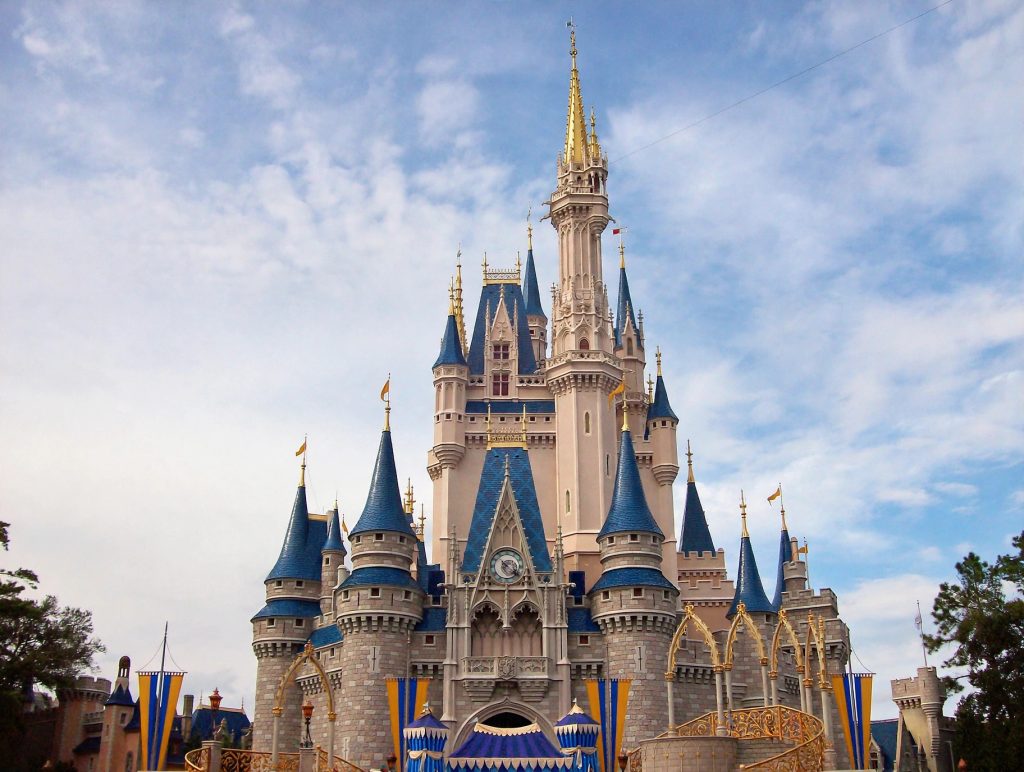
Photo: Cinderella Castle at Magic Kingdom. Photo by Rstoplabe14 Carlos Cruz, CC BY-SA 3.0, via Wikimedia Commons — treated to the paper’s photo grade.
Orlando Citizen by email
The weekly edition, in your inbox
One email, every Saturday: the week’s edition of Orlando Citizen — the week’s stories, rankings and winners, gathered in one place. Free, and you can unsubscribe at any time.
Related Stories
 TourismDisney World Union Contract Vote: Maintenance Workers Reject Disney Offer 735 to 231
 TourismOrlando Hotel Occupancy: Rooms 77.6% Full in the Week Ending Nov. 14, With Rates at $221
 TourismOrlando Airport Signature Aviation Expansion: GOAA Approves $26 Million Private-Jet Terminal and Hangars at MCO
Spotted an error? Tell us — corrections · How we rank