U.S. Moves to Close the Remote-Access Loophole for Advanced AI Chips, Effective Nov. 19
Effective upon its Nov. 19 publication, an interim final rule from the Bureau of Industry and Security requires licenses for covered advanced chips and servers bound for data centers anywhere in the world serving China-parented firms above 12 million TPP.
3 minute read
WASHINGTON — A company seeking the most powerful American computer chips never has to take delivery of a single box. Without the hardware ever crossing a border to do its work, a customer can rent the chips by the hour from a data center on another continent and train its models on them from afar. On Monday, the Commerce Department moved to close that route for the customers its export controls were written to keep away from the technology.
The Bureau of Industry and Security released the measure — an interim final rule, “Addressing Remote Access to Advanced Semiconductors” — on Nov. 16, 2026. Listed for public inspection at the Federal Register (FR Doc. 2026-23529, RIN 0694-AK50), the rule is scheduled for publication on Nov. 19, 2026, and its text makes it effective on publication, not before. Because an interim final rule takes effect without prior notice-and-comment, the 60-day public comment period opens after publication, and the agency can revise the text in response.
The new test: 12 million TPP, wherever the data center sits
At the heart of the rule is a new end-use control at section 744.24 of the Export Administration Regulations. An exporter must obtain a license to export, reexport or transfer covered advanced-computing items — chips and servers classified under ECCNs 3A090 and 4A090 and their related entries — when the exporter knows those items are destined for a data center, anywhere in the world, that provides or will provide more than 12,000,000 aggregate total processing performance (TPP) to or for companies headquartered in, or ultimately parented in, Macau or a Country Group D:5 destination, the arms-embargo group that includes China, Russia, Iran and Cuba. That threshold can be met inside a single facility or across linked data centers that share resources and balance workloads as a unified whole. Data centers already providing covered-scale compute to those customers have 90 days from the effective date to obtain a license to continue.
Separately, the rule imposes a destination-based license requirement on covered items shipped to five countries that BIS identifies as presenting a higher diversion risk: Indonesia, Malaysia, Singapore, Thailand and Brazil. Shipments to U.S.-headquartered recipients are excluded from that requirement, subject to reporting. In the same stroke, the rule formally rescinds the January 2025 “AI Diffusion Rule,” including its country tiers, which BIS states had never been enforced. BIS says the rule was written at the direction of the Treasury Department and the National Security Council.
Why Florida firms should read a chip rule
Florida is not a chip-fabrication state, yet the new control turns on knowledge and end use rather than geography of manufacture. Its reach extends to any exporter, cloud provider or data-center operator — including the data centers and logistics firms operating in Florida — whose covered hardware ends up serving a restricted-country customer above the threshold. Below 12,000,000 aggregate TPP, the new end-use control does not apply; above it, compliance turns on the question posed in the rule’s own text: what does the supplier know about who is renting the compute, and at what scale?
From here, the calendar is fixed: publication and effectiveness arrive on Nov. 19, starting the 90-day transition clock for existing data-center arrangements, while public comments run for 60 days after publication through regulations.gov under RIN 0694-AK50.
More National coverage: the National hub and the National archive. Related: Federal Funding Expires Dec. 11 and Immigration Appeals Shrink to 10 Days.
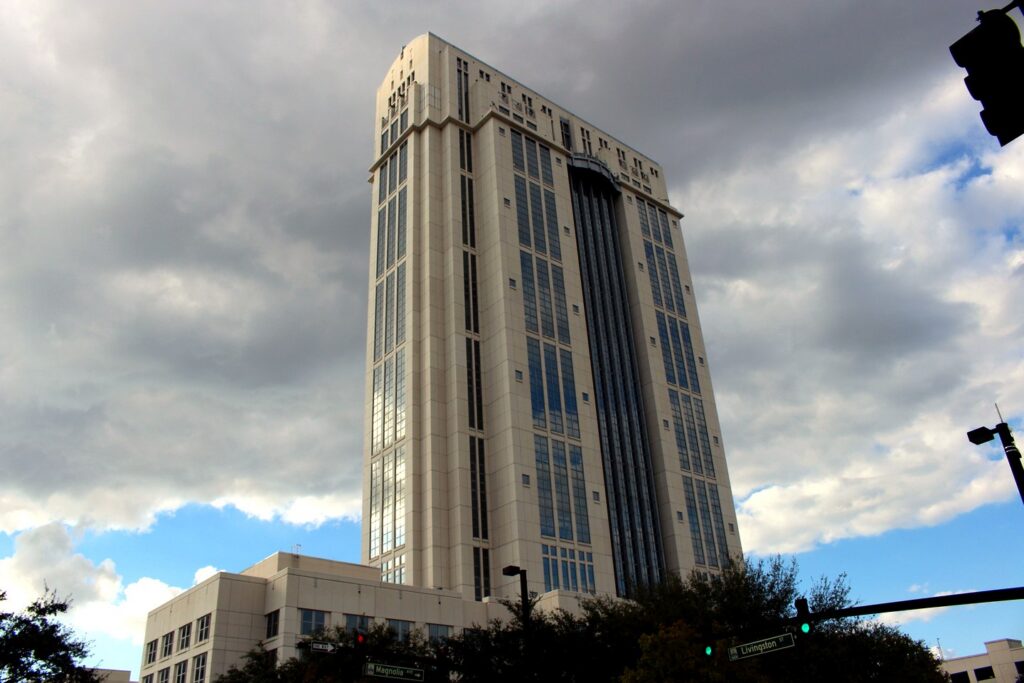
Sources & notes: Bureau of Industry and Security interim final rule, “Addressing Remote Access to Advanced Semiconductors,” released Nov. 16, 2026 (RIN 0694-AK50); Federal Register public-inspection listing, FR Doc. 2026-23529, read Nov. 18, 2026, confirming the document is unpublished and scheduled for publication Nov. 19, 2026. Threshold, ECCN scope, linked-data-center definition, five-country licensing, 90-day transition and AI Diffusion rescission as stated in the rule text and corroborated in published law-firm analyses of the text (Pillsbury; Katten) read this run. The rule is not in effect as of this story’s publication; the story says so. Photo: Orange County Courthouse (Rivera, CC BY-SA 4.0, via donor post).
Orlando Citizen by email
The weekly edition, in your inbox
One email, every Saturday: the week’s edition of Orlando Citizen — the week’s stories, rankings and winners, gathered in one place. Free, and you can unsubscribe at any time.
Related Stories
 NationalNew 401(k) Plans Must Enroll Workers Automatically: IRS Final Rule Sets the 3 Percent Default
 NationalImmigration Appeals Shrink to 10 Days: Final Rule Makes Dismissal the Default From Dec. 17NationalGreen Card Sponsors Would Have to Advertise Jobs for 90 Days — and Nurses Lose Their Shortcut
Editor’s Picks
Spotted an error? Tell us — corrections · How we rank