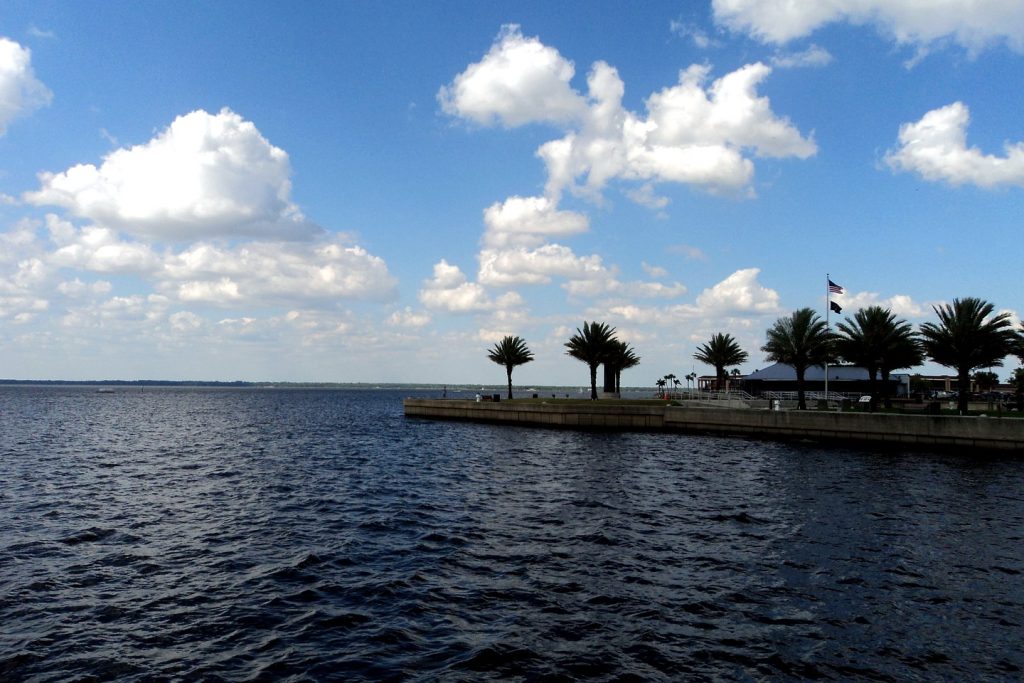
Florida Flood Emergency Grows to 21 Counties After Broward Takes 10 Inches in 12 Hours
With recovery centers in Brevard County closed by the weather and more than 10 inches of rain falling on Broward in 12 hours, Gov. Ron DeSantis expanded Florida's flood emergency to 21 counties running unbroken from the Georgia line to the Florida Keys.
5 minute read
TALLAHASSEE — For families still working through November’s first round of flooding, Wednesday brought an abrupt setback: in Brevard County, two recovery centers closed because of the weather itself. Farther south, Fort Lauderdale, Davie and Hollywood had taken more than 10 inches of rain inside twelve hours on Tuesday. By Wednesday afternoon, that one day of rain had redrawn the map of the 2026 fall flooding. Gov. Ron DeSantis signed Executive Order 26-232, adding seven counties to Florida’s state of emergency and bringing the total to 21 — a declaration that now runs, unbroken, from the Georgia line to the Florida Keys.
The seven counties added Wednesday — Broward, Duval, Flagler, Miami-Dade, Monroe, Putnam and St. Johns — join 14 others covered since earlier this month. Taking effect immediately, the order is deliberately narrow: it changes only one piece of the original declaration, the list of counties in Section 1, while ratifying and reaffirming everything else. The full amended list now encompasses Brevard, Broward, DeSoto, Duval, Flagler, Glades, Hardee, Hendry, Highlands, Indian River, Lake, Martin, Miami-Dade, Monroe, Okeechobee, Palm Beach, Putnam, Seminole, St. Johns, St. Lucie and Volusia.
Three orders in sixteen days
The expanding emergency began sixteen days earlier with a far smaller footprint. On Nov. 2, after a broad area of low pressure had crossed the peninsula from Oct. 31, the weather produced what the first order called “several occurrences of consequential flooding.” At 12:30 p.m. that day, with flash flood warnings in effect for portions of Brevard, DeSoto, Hardee, Highlands, Indian River, Martin and St. Lucie counties, Executive Order 26-227 declared a state of emergency across all seven. Two days later, on Nov. 4, as the St. Johns River began its slow rise, Executive Order 26-228 added Glades, Hendry, Lake, Okeechobee, Palm Beach, Seminole and Volusia, lifting the total to 14. Wednesday’s order is the second amendment, and its stated reason is new weather rather than old damage: the Broward County rain of Nov. 17 and the forecast the order recites, warning that “additional rainfall along the Florida East Coast over the next several days could impact previously flooded areas and cause additional damage to infrastructure and critical facilities.”
What the declaration actually does
Because Executive Order 26-232 ratifies the Nov. 2 declaration rather than replacing it, the response machinery set in motion earlier this month now stretches across all 21 counties. For residents inside the covered jurisdictions, some of the provisions are immediately practical: pharmacists may dispense up to a 30-day emergency refill of maintenance medication to people who live in a covered county, and the Department of Transportation may waive tolls, close roads and waive size and weight limits for vehicles carrying relief supplies. Behind those measures sits the state’s command structure. The Executive Director of the Division of Emergency Management serves as State Coordinating Officer, directed to execute the state’s Comprehensive Emergency Management Plan, including logistical, rescue and evacuation operations. The Adjutant General is ordered to activate the Florida National Guard as needed, and the Director of the Florida State Guard to activate that force as needed. The order also carries financial reach: the Florida Housing Finance Corporation is authorized to distribute housing funds under section 420.9073, Florida Statutes, to counties and municipalities inside the declared area — authority that now reaches Duval, Broward, Miami-Dade, Monroe, Flagler, Putnam and St. Johns as well.
Where a resident goes
For households still working through the first round of flooding, the state’s practical front door is a network of Multi-Agency Resource Centers — one-stop locations, in the Division of Emergency Management’s words, where “disaster-impacted residents can connect with local & state partners for recovery resources & support.” Visitors are asked to bring identification, proof of residence, insurance information and documentation of their losses. The division’s fall-flooding page lists centers at the Hoke Public Library in Jensen Beach for Martin County, at the Okeechobee County Public Library, and at the Wells Recreation Center in Riviera Beach for Palm Beach County, along with two Brevard County sites — the Tony Rosa Community Center in Palm Bay and the West Melbourne Veterans Memorial Complex — that were both closed on Wednesday, Nov. 18, because of the weather itself. Beyond the centers, State Emergency Response Team human-services teams are canvassing neighborhoods and following up with households in Brevard, Palm Beach and Okeechobee counties. The new rain is arriving on top of a river that has not finished with the old: the St. Johns River above Lake Harney was back in moderate flooding at 9.0 feet on Wednesday, as the Citizen’s Weather desk reported in its Wednesday coverage, with a flood watch in effect through Friday.
What happens next
Even as the map widens, the clock does not reset. Executive Order 26-232 expires when the original order does: Executive Order 26-227 took effect Nov. 2 for sixty days unless extended, and Wednesday’s amendment adds no new days. What it adds is geography — bringing the state’s emergency powers, its housing money and its recovery centers to the counties that the second round of rain has now put in the water’s path. As the rain continues, the Division of Emergency Management maintains its fall-flooding page with center hours, boil-water notices and school-closure links.
More from the State desk and the State archive. Local conditions and river forecasts are with the Citizen’s Weather desk.
Sources & notes: Executive Order 26-232 (Emergency Management — Amending Executive Order 26-227 — 2026 Fall Flooding), Office of the Governor, issued Nov. 18, 2026 (governor’s executive-order register, entry submitted Nov. 18, 2026, 4:04 p.m.; the two-page order was read in full from the official PDF; Section 1 county list, the Nov. 17 Broward rainfall figure of “over 10 inches within a twelve-hour period” in Fort Lauderdale, Davie and Hollywood, the ratification in Section 2 and the effective/expiry clause in Section 3 are quoted or paraphrased from the order itself). Executive Order 26-227, Nov. 2, 2026 (full text, Florida Department of State PDF): seven original counties, flash flood warnings as of 12:30 p.m. Nov. 2, the State Coordinating Officer designation, National Guard and State Guard activation, the 30-day prescription-refill provision, the transportation waivers, the section 420.9073 housing-funds authorization, and Section 15’s sixty-day term. Executive Order 26-228, Nov. 4, 2026, as listed on the Florida Division of Emergency Management’s 2026 Fall Flooding page (seven counties added, fourteen total). Resource centers, hours, the Nov. 18 Brevard closures and the SERT human-services outreach are from the Division of Emergency Management’s 2026 Fall Flooding page, read Nov. 18, 2026; the page had not yet been updated to list Executive Order 26-232 when read. St. Johns River conditions are the Citizen Weather desk’s, linked above. Photo: Orlando Citizen file photograph, first published with the Citizen’s St. Johns River flood coverage.
Orlando Citizen by email
The weekly edition, in your inbox
One email, every Saturday: the week’s edition of Orlando Citizen — the week’s stories, rankings and winners, gathered in one place. Free, and you can unsubscribe at any time.
Related Stories
 StateFlorida Bids for the U.S. Space Academy: UCF in 2028, Kennedy Space Center by 2031StateNo Special Session for Amendment 3: Florida’s New Leaders Say the Property-Tax Cut Takes Effect Jan. 1 on Its OwnStateBoyd and Garrison Take the Gavels: Florida’s New Legislature Organizes Around One Word — Affordability
Editor’s Picks
Spotted an error? Tell us — corrections · How we rank