In Paris, the Police Marched on Their Own Ministry
After two months on France's protest lines — a stretch that union figures say has left 1,600 officers and gendarmes injured — several hundred police officers marched in Paris on Wednesday and pitched tents outside the Interior Ministry, demanding that a risk allowance unchanged since 2019 be raised to 35 percent of base pay.
4 minute read
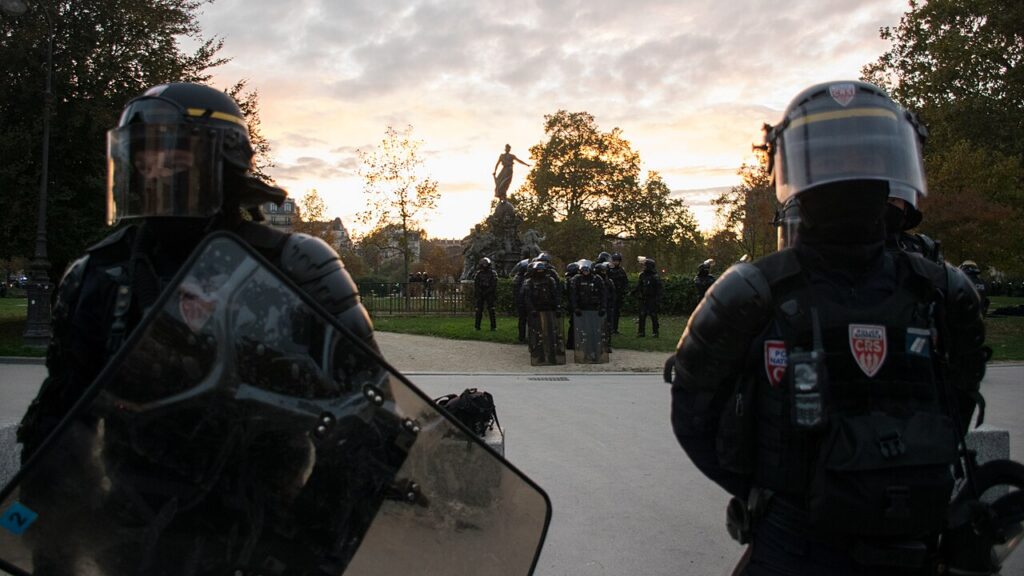
PARIS — Since September, France’s police officers have staffed the Saturday marches, the school blockades and the riot lines of an autumn of street unrest. On Wednesday morning at the Champs-Élysées roundabout, several hundred of them formed up once more — called out not to police a demonstration, this time, but to be one. They marched toward the Élysée Palace and on to the Place Beauvau, the seat of the Interior Ministry, where they pitched tents on the pavement and demanded an immediate increase in a risk allowance that has gone unchanged since 2019.
By the end of the morning, they had been received by the minister himself, Laurent Nuñez. Still, the procession — called by the Alliance Police Nationale union under the banner “La République, c’est nous,” or the Republic is us — marked the moment when two months of street unrest turned inward, setting the officers who protect the government in open dispute with it over the indemnité de sujétion spéciale de police, the special police allowance known as the ISSP.
The demand, and the offer
At the center of the standoff is the gap between immediate strain and distant relief. The ISSP stands at 28.5 percent of an officer’s base salary and has not been raised since 2019. Alliance, joined by the Un1té and UNSA Police unions, is demanding that the rate rise to 35 percent, immediately and in phases. At a meeting at the Interior Ministry on Friday, Nov. 13, Mr. Nuñez offered a slower path instead: a five-point increase across three stages — one point in April 2027, two points in 2028 and two points in 2029, lifting the allowance to 33.5 percent. The ministry said the plan was justified by the unprecedented risks officers now face. The unions rejected it. Another meeting with the ministry is scheduled for Dec. 15.
An exhausted force
Behind the pay dispute lies a mounting physical toll. Union figures presented this week put the number of police officers and gendarmes injured during recent weeks of protests and urban violence at 1,600. On Tuesday, the latest national day of action, several hundred members of the CRS riot police scheduled medical appointments in a coordinated absence to circumvent the ban on police strikes. Counting from union data, Le Monde found almost 30 of the 63 CRS companies nationwide affected, with nearly 1,000 officers attending appointments — figures the Interior Ministry declined to confirm or comment on. In Marseille, according to the unions, not a single unit was available for crowd control on Tuesday.
“The interior minister was warned. He knew this would happen,” Yoann Maras, a spokesman for Alliance, told Le Monde. Under Fabien Vanhemelryck, the union’s secretary general, who has led the campaign for the increase, Alliance has announced a “black day” of national mobilization for Nov. 26. The confrontation is also running into December’s public-sector professional elections, a contest in which the police unions are campaigning against one another as much as against the ministry.
Why it matters beyond the Place Beauvau
For the government, the bind is arithmetic as much as politics. The officers being asked to accept a phased, five-point rise spread over three years are the same ones the state needs on the streets this Saturday, when another round of demonstrations is expected, and on every Saturday the movement continues. Having deployed more than 70,000 officers on the movement’s biggest days, the Interior Ministry cannot treat the exhaustion in its ranks as a side issue. Yet a government caught between a budget it cannot pass and a deficit it is trying to hold at 5 percent of gross domestic product cannot easily find the money for a quick settlement. For now, the tents on the pavement at the Place Beauvau remain symbolic. By Dec. 15, the ministry must reckon with what happens if the people holding the line decide that symbolism is no longer enough. More of the desk’s France coverage is in the Global News section.
Featured image: A Paris demonstration during the autumn protest movement, Nov. 5, 2026. Photo: Jules*, CC BY-SA 4.0, via Wikimedia Commons.
Sources & notes
- The Wednesday march — several hundred officers, the Champs-Élysées rendezvous, the march toward the Élysée and the Place Beauvau, the tents, and the reception by the Interior Minister: AFP-sourced video reporting carried Nov. 18, 2026 (Roya News English and partner carriers) and French video reports of the Alliance encampment the same morning, one of which counted nearly 400 officers at the ministry.
- The ISSP figures (28.5 percent of base salary, unchanged since 2019; the demand for 35 percent), the Nov. 13 ministry meeting, Mr. Nuñez’s staged offer (one point in April 2027, two points in 2028, two points in 2029, to 33.5 percent) and its rejection by the unions: Le Monde, Nov. 17, 2026, and wire summaries of the union position, Nov. 18, 2026.
- The CRS medical-appointment action on Nov. 17 (almost 30 of 63 companies and nearly 1,000 officers, by Le Monde’s count from union data; the ministry declining to confirm), the Marseille crowd-control gap, the Yoann Maras quotation and the Nov. 26 “black day”: Le Monde, Nov. 17, 2026.
- The figure of 1,600 officers and gendarmes injured during recent weeks’ protests and urban violence: union figures as presented in reporting on Nov. 18, 2026; the ministry has not published its own total, and the figure is carried here as the unions’ claim.
- The Dec. 15 meeting date: union reporting of the ministry calendar, Nov. 18, 2026.
Orlando Citizen by email
The weekly edition, in your inbox
One email, every Saturday: the week’s edition of Orlando Citizen — the week’s stories, rankings and winners, gathered in one place. Free, and you can unsubscribe at any time.
Related Stories
 Global NewsUK Inflation Rises to 3.6 Percent, a One-Year High, as Fuel Costs Climb
 Global NewsParis Unrest Enters Its Third Month: Bans in Force, Police in the Streets and a Saturday to Watch
 Global NewsFrance’s Assembly Rejected Its Budget 458 to 0. On Friday, the Senate Starts From the Government’s Text
Editor’s Picks
Spotted an error? Tell us — corrections · How we rank