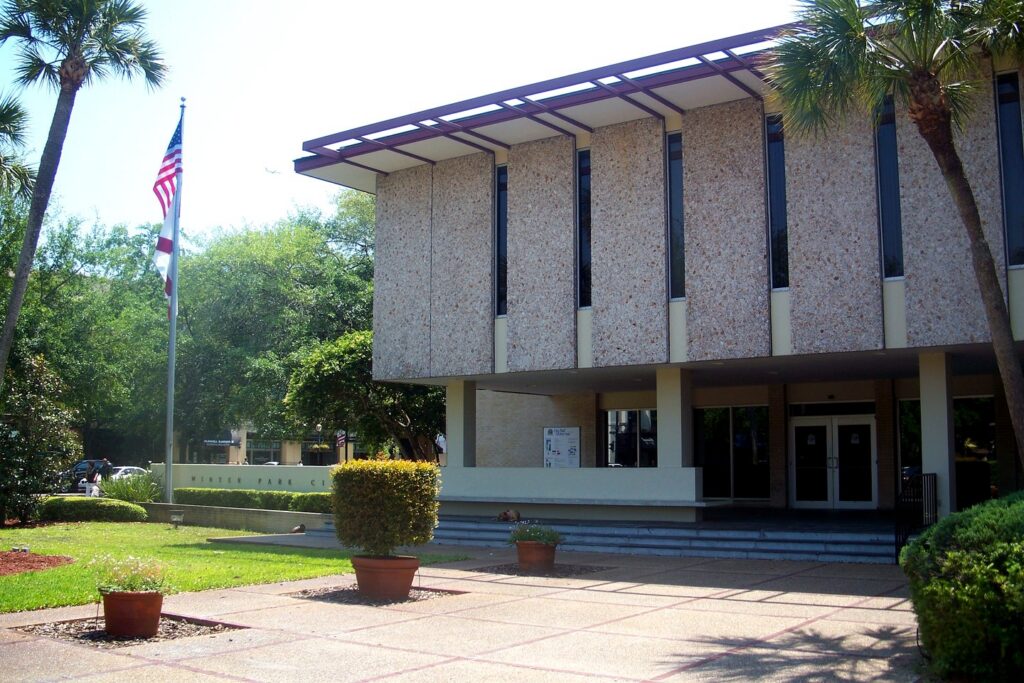
Winter Park Paid Parking at Dinky Dock: A $20 Day at a Public Lake Is a Paywall
Winter Park proposes $2–$3 an hour, $20 a day, for nonresidents at Dinky Dock. A public shore priced by ZIP code is a paywall, not a management plan.
5 minute read
OPINION — Fair Share
Start at the ramp, early, before the lot fills.
Dinky Dock is a 1.56-acre park on Lake Virginia, near Rollins College, with a boat ramp and limited parking. On weekends it is busy — people from surrounding cities launch boats and jet skis there, trailer parking is first-come, first-served, and once the trailer spaces fill, boaters have to find parking offsite. That picture — a small, loved, over-subscribed public place — is the whole argument. The question is what a city does about it: manage the crowd, or charge the crowd by ZIP code.
On November 11, the Winter Park City Commission approved the ordinance establishing a Paid Parking Pilot Program, Ordinance 3385-26, on first reading. It still needs a second reading. The city’s meeting recap publishes no vote counts and none of the pilot’s streets, hours or rates, so what we know about the price comes from September, when staff proposed it and the commission voted 5–0 to advance it: nonresidents would pay $2 to $3 an hour, or a flat $20 a day, during a 12-hour enforcement window, plus a vendor transaction fee of 25 to 35 cents paid by the parker. Winter Park residents would park free — after registering up to two vehicles per property.
Do the math with me
Twenty dollars a day. Say it plainly, because the slide deck did not.
Twenty dollars to park at a public boat ramp. Not a garage in Manhattan. A ramp on a lake that belongs, in every way that should matter, to the public that can reach it. Add the transaction fee the parker — not the city — pays the vendor. Add the $30 parking fine the city set in September, up from $25, waiting for anyone who misjudges the window. A morning’s fishing, priced by the hour, with a fine at the end of a misread sign.
Clarence Howard is right about one thing, and I will say it before I answer him. He is right that a crowded park is not free to run, and that “somebody always pays” is a more honest sentence than “free.” Where he is wrong is in who he has chosen to bill. The nonresident at Dinky Dock is not an abstraction. In a region stitched together by work, the person who lives one city over is the person who cleans, cooks, teaches and builds in this one. Residency lines on a map of Orange County do not describe two economies. They describe one economy, sorted into people who get a registration portal and people who get a meter.
A registration is also a price
Notice what “free” now requires. Under the September design, a Winter Park resident parks free only after registering — proving residency, registering vehicles, renewing. A neighbour in Orlando gets no portal at all, just the rate. And the one place where that line was tested, it collapsed on contact with the city’s own promises: Lake Baldwin Park was pulled from the pilot on September 15, six days after it was voted in, because a settlement agreement signed in 2002 requires Winter Park and Orlando residents to have equal access, on the same terms, to the parks around that lake. The city manager’s release said so, and cited the input of citizens besides.
That agreement understood something the pilot has forgotten. These lakes were never one city’s private amenity. They are a shared shore, used by a shared region, and the moment you price access by address you have to start explaining — to a court, to a neighbour, to yourself — why the shore changed hands.
Margaret Shepherd will tell you, fairly, that the pressure at Dinky Dock is real, and she is right — nobody who has seen that lot on a Saturday should pretend otherwise. But pressure is an argument for managing a place: for the occupancy counting the September design already promised, for time limits honestly enforced, for the kind of unglamorous administration that keeps a ramp usable. It is not, by itself, an argument for a paywall. Scarcity tells you a place needs a steward. It does not tell you the steward should be a payment app.
Where this gets decided
This is not settled law, and nobody should write about it as if it were. Ordinance 3385-26 has passed a first reading; the second reading is where the pilot becomes real, and the city’s recap does not even publish the terms that reading will vote on. That is the moment to show up — with one question for the commission: if the lake is public, why does the public’s price depend on its address?
A public shore with a $20 door is not being managed. It is being sold back, by the hour, to the region that already shares it.
Read the other sides: Clarence Howard argues the user, not the taxpayer, should pay, and Margaret Shepherd asks what a narrow, counted test at Dinky Dock would actually prove. The Citizen’s news report is the Government desk’s account of the November 11 meeting, and all three columns live on the Opinion hub.
Sources & notes
City of Winter Park, Regular Meeting Recap, November 11, 2026 — Ordinance 3385-26 (Paid Parking Pilot Program) approved on first reading; the recap publishes no vote counts and no pilot streets, hours or rates — checked via the Citizen’s Government desk report, Winter Park City Commission: Paid Parking Pilot and Red-Light Cameras Pass First Reading Nov. 11. Winter Park City Commission, September 9, 2026 meeting record and staff presentation — the 5–0 vote to advance a two-park pilot and the proposed terms ($2–$3 per hour for nonresidents, $20 flat day rate, 8 a.m.–8 p.m. enforcement, $0.25–$0.35 vendor transaction fee paid by the parker, residents free after registering up to two vehicles per property) — proposals, not terms published in the November recap. City Manager Randy Knight’s September 15, 2026 release removing Lake Baldwin Park from the pilot, citing the November 2002 Baldwin Park Settlement Agreement and citizen input, as reported by Bungalower and the Winter Park Voice. Winter Park Chamber of Commerce visitor brochure (free on-street parking up to 3 hours; free 4-hour municipal lots) and the City’s Merchant Employee Parking Program page. Winter Park Voice, September 15, 2026 (parking fine raised from $25 to $30). Read the other two columns in today’s crossover: the Opinion hub carries all three.
Orlando Citizen by email
The weekly edition, in your inbox
One email, every Saturday: the week’s edition of Orlando Citizen — the week’s stories, rankings and winners, gathered in one place. Free, and you can unsubscribe at any time.
Related Stories
Editor’s Picks
Spotted an error? Tell us — corrections · How we rank