Gatorland: The 1949 Original, Southchase’s Own
Before the theme parks, there was Gatorland — Owen Godwin's 1949 roadside attraction at 14501 South Orange Blossom Trail, still family-run, still the Alligator Capital of the World.
3 minute read
Every other Orlando attraction was built by a corporation. Gatorland was built by a family, on cattle land, before Walt Disney had bought a single Florida acre — and from Southchase it is the corridor’s famous name, and it is Southchase’s own: a straight drive north on the Trail to 14501 South Orange Blossom Trail, at the community’s northern edge, where the magazine’s rankings place it. It is a Southchase business, and this page claims it as one — the world-famous anchor at the north end of Southchase’s own road. Gatorland’s own fact sheet dates the park to December 1949, when Owen Godwin Sr. opened it as the Florida Wildlife Institute; it took the name Gatorland in 1954, and the Godwin family still owns and runs it, billing it — as it has for decades — as the Alligator Capital of the World.
What 110 acres of Old Florida looks like
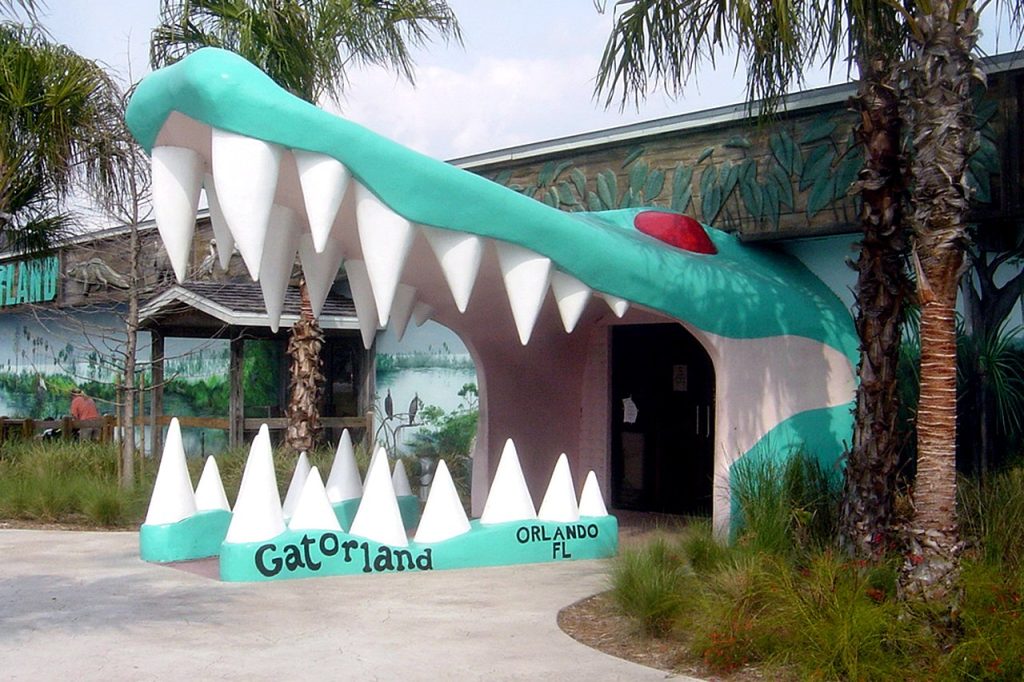
The park covers 110 acres along the Trail, and its layout honors its roadside origins: ponds, boardwalks and a breeding marsh with an observation tower, where the big alligators live the unbothered life that the 1984 film Indiana Jones and the Temple of Doom borrowed for its marsh scenes, per the park’s published history. The entrance is the icon — a giant gator-mouth doorway conceptualized and built in 1962 by Frank Godwin, the founder’s son, which survived even the serious fire of November 2006 that destroyed the original gift shop and the Godwin family home; the family rebuilt, investing millions while keeping the mouth. Inside, the program mixes shows, a swamp walk, an aviary and a petting zoo with the modern additions, including the Screamin’ Gator Zip Line installed in 2011. The Gatorland Express train, opened in 1961, is claimed by the park as among Central Florida’s oldest amusement attractions — a claim that is hard to argue with from 1949’s home turf.
Conservation with teeth
The modern park is also a working rescue operation: Gatorland buys or takes in nuisance alligators from trappers — animals that would otherwise be killed — and houses rare white leucistic alligators alongside its thousands of alligators and crocodiles. That rescue pipeline is the honest answer to the fair question of what a gator park is for in 2026: education, preservation of an Old Florida landscape, and a second chance for animals caught in Florida’s suburban sprawl — sprawl that, around Hunter’s Creek and Southchase alike, surrounds the park.
Visiting from Southchase
For Southchase residents, Gatorland is the rare world-famous attraction that functions almost as a neighborhood amenity: a straight drive north on the Trail, close enough for a half-day rather than an expedition — it is Southchase’s own landmark, and we label it that way. Pair it with lunch on the corridor from our where-to-eat guide, check the park’s own site for the day’s hours and show schedule before you go, read the magazine’s full Gatorland record, and find it on the Orlando Top Spots Map. Visitors based elsewhere in Orlando should note the geography honestly — this is south Orlando, a drive from the resort districts — and that drive is part of the experience: you exit the theme-park bubble and arrive somewhere that predates it by a generation.
Why Gatorland belongs in a Southchase guide at all
Attraction guides usually file Gatorland under generic Orlando, and geographically that undersells what it means up and down this corridor. It sits at the northern edge of the Southchase subdivisions, on the same Trail residents drive daily — close enough that Southchase children grow up with the gator-mouth entrance as a landmark the way other children grow up with a water tower, and school breaks and visiting grandparents route here by default. That familiarity can breed a local blind spot, so it is worth saying out loud: an attraction founded in 1949, still in the founding family’s hands, that rescued itself after a devastating 2006 fire and now rescues nuisance alligators as part of its daily work, would be a headline asset for any community in America. It is Southchase’s to claim — and Hunter’s Creek is lucky to have it just up the road.
Photo: Bobak, CC BY-SA 2.5, via Wikimedia Commons.
Sources & notes
The park history in this article was checked against:
- Gatorland — Historical Time Line (official) — the 1949 Florida Wildlife Institute opening, the 1954 renaming, Frank Godwin’s 1962 gator-mouth entrance design, and the November 6, 2006 fire that destroyed the gift shop and executive offices.
Orlando Citizen by email
The weekly edition, in your inbox
One email, every Saturday: the week’s edition of Orlando Citizen — the week’s stories, rankings and winners, gathered in one place. Free, and you can unsubscribe at any time.
Related Stories
Editor’s Picks
Spotted an error? Tell us — corrections · How we rank
