The Woman Who Lived in an Eagle’s Nest: Maitland’s Raptor Hospital Family Day
Doris Mager's 1979 nest sit-in funded the Audubon Center for Birds of Prey, which now treats 600–800 raptors a year. Pair it with Lake Lily's ibis for Maitland's best family half-day.
3 minute read
The best family day in Maitland begins with a woman who once lived in an eagle’s nest. In June 1979, Audubon staff member Doris Mager climbed into an inactive bald eagle nest fifty feet up a longleaf pine and stayed for six days and five nights — to raise awareness of a species collapsing under DDT, habitat loss and illegal shooting, and to raise the money for a raptor hospital that did not yet exist. The donations came. On October 19, 1979, the Audubon Center for Birds of Prey opened in Maitland. Pair a morning there with an afternoon among Lake Lily’s ibis, and you have the area’s best family half-day — one with a genuinely great story at its center.
Start with the raptors
The center, at 1101 Audubon Way on three shaded acres along the southeast shore of Lake Sybelia, is described by Audubon Florida as the premier raptor rehabilitation facility in the eastern United States — the largest volume of eagle, owl, falcon, hawk and kite patients east of the Mississippi. The modern numbers carry Mager’s legacy: the center admits roughly 600 to 800 injured or orphaned raptors a year, more than 200 of them owls, treats between 60 and 100 bald eagles annually, and has released more than 750 rehabilitated eagles back into the wild across its history. Florida’s recovery frames the work — from just 88 documented nesting pairs in 1973, the state now counts around 1,500. About thirty permanent residents, whose injuries prevent release, are the public visit: bald eagles at close, respectful range, hawks and falcons in the aviaries, and owls in the Sitek Smith Owl Aviary, a $675,000 project whose completion brought the center’s public reopening in February 2026 after six months of construction.
What makes the visit work for children is the honesty of the place. This is a working hospital that welcomes guests, not an attraction that happens to have birds: rehabilitation staff and volunteers treat patients on site, the resident birds are ambassadors with individual stories, and the education programs — camps, school visits, internships — run alongside the medicine. The center also hosts Audubon EagleWatch, the citizen-science program whose volunteers across more than forty Florida counties monitor a fifth of the state’s nesting eagle population. The center is open Tuesday through Sunday.
The deeper Maitland connection
The center is not an accident of real estate. Florida’s conservation movement was quite literally founded in this small city: on March 2, 1900, the first meeting of the Florida Audubon Society convened at the Dommerich estate in Maitland to organize protection for the state’s birds. Audubon bought the Lake Sybelia property in 1959 with funds donated by benefactor Lisa von Borowski. Mager’s first patient predates the center by sixteen years — a red-tailed hawk with an infected foot, brought to the Audubon gift shop in 1963 and taken home to be nursed, the start of a home rehabilitation practice that at one point kept as many as seven injured bald eagles in her yard. The center is that impulse, institutionalized.
Then walk it off at Lake Lily
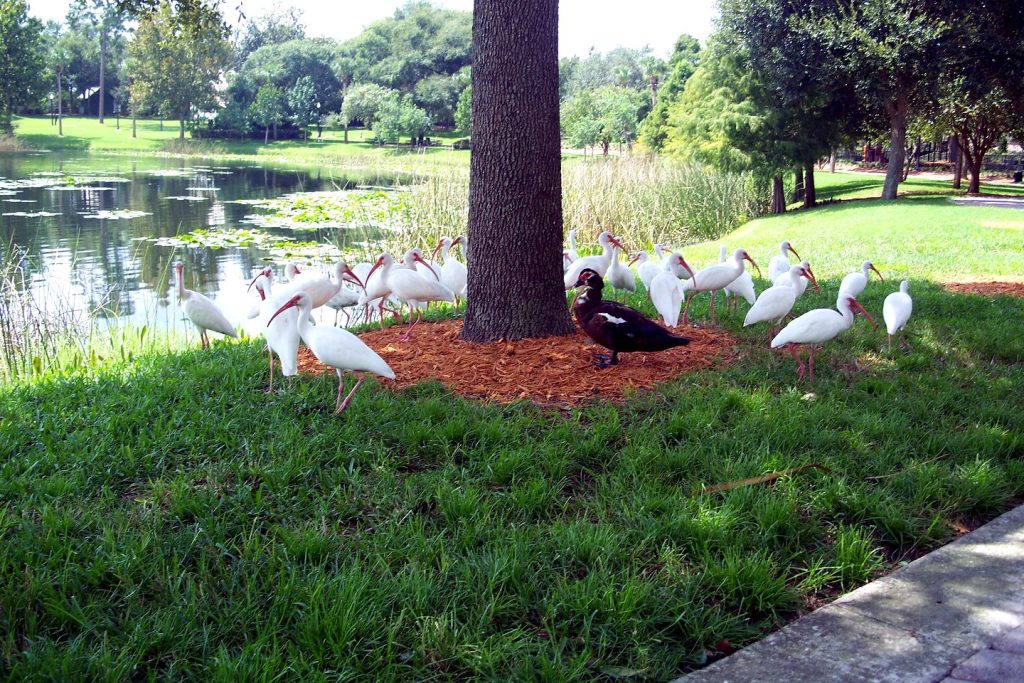
Drive a few minutes to Lake Lily Park and hand the afternoon to the wild-but-friendly birds: ibis flocks working the lawn, turtles at the boardwalk, ducks in the shallows — a gentler register after the raptors’ intensity, and a good place for younger kids to practice the binoculars the eagles did not require. The loop is short and step-free, the playground burns off the car energy, and the Waterhouse Residence Museum adds a Victorian chapter for older children. Antonio’s market, across the avenue, handles picnic supplies; see our eating guide.
Both stops are on the Orlando Top Spots Map, and the pairing is the point: a hospital where Florida’s eagles get their second chances, then a small lake where the everyday birds remind you what the second chances are for. Mager died in 2023 at 98. The nest she sat in is long gone. The center she funded from inside it treats hundreds of birds a year — bring the kids, and tell them the nest story on the drive over.
Photo: Ebyabe, CC BY-SA 3.0, via Wikimedia Commons.
Orlando Citizen by email
The weekly edition, in your inbox
One email, every Saturday: the week’s edition of Orlando Citizen — the week’s stories, rankings and winners, gathered in one place. Free, and you can unsubscribe at any time.
Related Stories

Editor’s Picks
Spotted an error? Tell us — corrections · How we rank
