Celebration CDD, Explained: The District That Runs the Town’s Streetlights, Lakes and Mosquito Control
The Celebration CDD is a special-purpose local government, not the homeowners' association: what it maintains, how its non-ad valorem assessments work, and who to call for what.
7 minute read
If a street light is out on your street, a lake needs attention or mosquitoes are biting, the body responsible is not a city council and not the homeowners’ association. It is the Celebration Community Development District, usually shortened to the Celebration CDD. The district is an independent local unit of special-purpose government, created under Chapter 190 of the Florida Statutes and established by the Florida Land and Water Adjudicatory Commission. That legal status is the starting point for understanding Celebration, because the town is unincorporated and has no city government of its own.
This explainer sets out what the district is, what it looks after, what it does not do, how it is paid for and who to contact when something needs fixing. It sits alongside our guide to CROA and Celebration Town Hall and our account of how Disney built the town, and the full set of Celebration explainers is gathered on the Celebration news hub.
What a community development district is
A community development district is a form of local government Florida uses to plan, finance, build, operate and maintain community-wide infrastructure in a defined area. The Celebration CDD’s own site describes the model as an alternative method of planning, acquiring, operating and maintaining community-wide improvements, intended to provide infrastructure generated by growth without overburdening other governments and their taxpayers. The ordinance establishing the Celebration district authorises it to issue bonds and to finance, plan, establish, acquire, construct, equip, operate and maintain systems including stormwater management, drainage, bridges and culverts, roadways, street lights, landscaping, sidewalks and boardwalks.
The district is governed by a five-member Board of Supervisors. According to the district’s published questions page, supervisors were elected initially by landowners and the board then moved to a general election format. For Celebration, that transition took place in 2004, after two thresholds were met: ten years in existence and 500 registered voters. General elections for the board are overseen by the Supervisor of Elections, and supervisors are subject to state ethics and financial disclosure laws, as the district’s site states.
What the district looks after
The district’s responsibilities are the shared, public parts of the town. Its homepage puts the list plainly: street lights, waterways, mosquito control, public common areas including medians and trees, and alleys. Its questions page gives the fuller maintenance list:
- The downtown lake and esplanade, including the shade structures and the interactive fountain.
- Common-area landscaping, including all street trees in the district’s right of way, trimmed for safety purposes.
- Sidewalks, boardwalks and trails.
- Alleys and sidewalks.
- Street lighting.
- Hardscape, such as fences and signs.
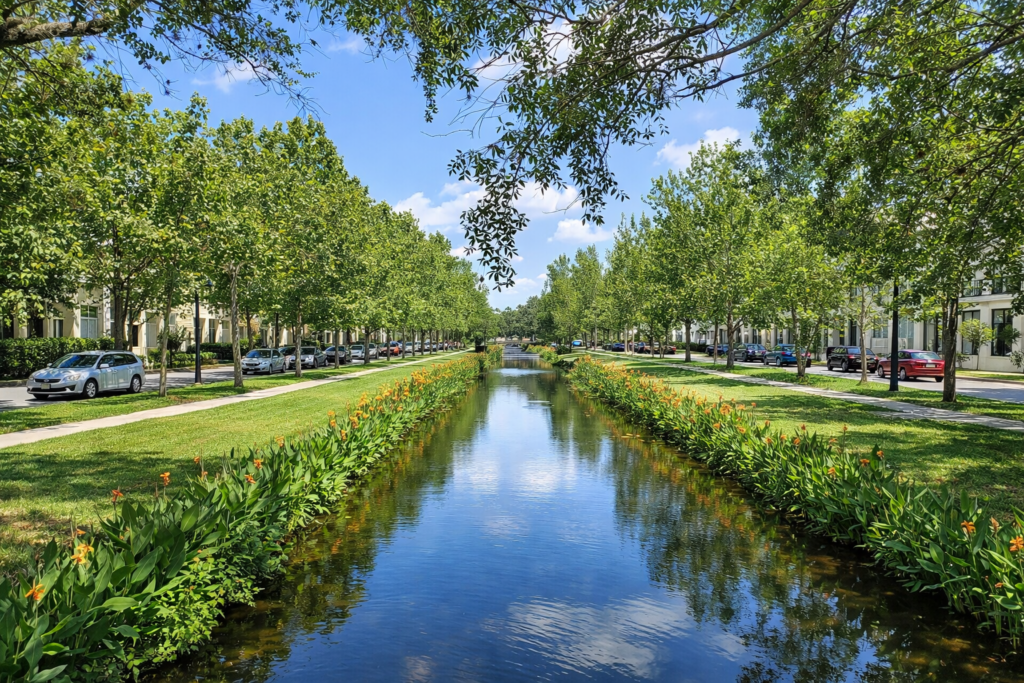
- Stormwater ponds and drainage structures.
- Mosquito control and aquatic weed control.
The district also supplements security services by hiring off-duty deputies, according to the same page. The official welcome packet issued for new residents summarises the same division of labour in similar terms: roadway lights, street sweeping, common-area landscaping, street trees and turf, trails, alleyways, aquatic weed and mosquito control, and maintenance of the lakes, stormwater retention areas and drainage system.
Signs are one small but visible example of where the district’s authority begins. The district’s homepage states that signs in the district’s easements, the right-of-way areas between the kerb and the pavement, are not permitted at any time, whether in front of homes or in common areas.
What the district does not do
The district is a public, governmental body responsible for public common areas. The Celebration Residential Owners Association, known as CROA, is a separate, private body responsible for residential properties and private amenities. The district’s site draws that line explicitly, and it matters for everyday problems. Homeowner issues, including dues, covenants, active parks and pools, go to CROA on 407-566-1200, not to the district.
Two other common calls also sit elsewhere. Utilities, meaning potable water, sewer and reclaimed water, and utility billing, are handled by the Enterprise Community Development District, a distinct district also based in Celebration, on 407-566-4132. Downtown and Town Center matters, including Town Center events, shops and restaurants, go to LEXIN on 407-566-4007. Our separate guide to Celebration utilities and county services covers the Enterprise district and county services in more detail, and the Celebration area portal carries the wider town directory.
How the district is funded
The district’s questions page states that the cost of operating a district is borne by those who benefit from its services. Property owners in the district are subject to a non-ad valorem assessment, which may appear as a line item on the annual Osceola County real estate property tax bill issued by the county tax collector. The page is clear that the assessments are not taxes as such, although they appear on the tax bill and are collected in the same manner as property taxes.
The assessment has two parts. The first is debt service, which repays the bonds issued to finance infrastructure and facilities the district acquired or constructed. The district states that this component is fixed for the term of the bonds, unless lowered through a refinancing, and that each property’s annual debt assessment is based on use and benefit and on the property’s pro-rata share of the cost of the public infrastructure. Owners may pay down the debt assessment early, in part or in whole. The district also notes that several earlier bond issues have been paid off, so some residents are levied only for annual maintenance assessments.
The second part is maintenance, an annual assessment for the operations and maintenance of district infrastructure and facilities. Those costs sit in the district’s fiscal year budget and may vary from year to year, depending on actual costs and contracts with vendors. Each year the Board of Supervisors advertises and holds a public hearing to adopt the annual budget and set the level of operations and maintenance assessments. A schedule showing villages and product types, with the resulting debt and maintenance assessments, is published at the end of each fiscal year’s adopted budget, according to the district.
No assessment figure is quoted in this article, deliberately. Amounts vary by village and product type and change with each adopted budget, so the figure that applies to a particular home is the one in the current adopted budget and on that property’s tax bill, not a figure carried in a general explainer.
Meetings, records and how to follow decisions
The district conducts its business under Florida’s Sunshine Law. Its questions page states that all meetings, workshops and hearings are open to the public, unless the board meets in a closed executive session, that public hearings are held on annual budgets and rulemaking, and that the district’s financial records are subject to an annual independent audit. The district’s public records are available to the public under the Public Records Law.
Agendas, minutes and the published meeting schedule are posted on the district’s website. Recent published material places regular meetings at the District Office at 313 Campus Street, Celebration, FL 34747. Because meeting dates and times are set by an adopted annual schedule and can change, residents should check the current schedule and agenda package on the district’s site before attending, rather than relying on a standing day and time. An agenda is a plan for a meeting. It is not a record of a decision, and this desk reports board decisions from adopted minutes, not from agendas.
Who to call for what
- Street lights, waterways and lakes, mosquito control, public common areas, medians, street trees and alleys: Celebration CDD main office, 407-566-1935. Mosquito hotline: 800-203-6485.
- Homeowner issues, dues, covenants, active parks and pools: CROA, 407-566-1200.
- Utilities, potable water, sewer, reclaimed water and utility billing: Enterprise CDD, 407-566-4132.
- Downtown and Town Center events, shops and restaurants: LEXIN, 407-566-4007.
The district also publishes two after-hours emergency-only numbers on its homepage, 407-908-2399 and 407-947-1238. For the history of how this structure came to replace direct Disney control, see Celebration’s villages, explained, and browse past coverage in the Celebration News archive.
More from this desk: the Celebration news hub, the Celebration area portal and the Celebration News archive. See also CROA and Celebration Town Hall, explained, Celebration by the numbers, Celebration trails, lakes and parks guide.
Sources & notes: Celebration Community Development District, celebrationcdd.org, homepage and Questions page, for the district’s legal status under Chapter 190, its maintenance responsibilities, the CROA distinction, board election history, Sunshine and public records position, assessment structure and all telephone numbers; Celebration official welcome packet (Town Hall, March 2025 edition, hosted at visitcelebration.org) for the summary of district services. No assessment amounts are stated because the district publishes them by village and product type in each adopted budget. Read November 15, 2026.
Orlando Citizen by email
The weekly edition, in your inbox
One email, every Saturday: the week’s edition of Orlando Citizen — the week’s stories, rankings and winners, gathered in one place. Free, and you can unsubscribe at any time.
Related Stories
Editor’s Picks
Spotted an error? Tell us — corrections · How we rank
