Hunter’s Creek, Explained: The Master Plan That Grew Up Well
Four thousand acres, seven parks, its own retail system and a 1949 alligator park at the gate: how south Orlando's master-planned heavyweight works, and how to do a day there well.
3 minute read
Most Orlando neighborhoods are accidents of subdivision. Hunter’s Creek is the opposite: a roughly 4,000-acre master-planned community in south Orange County that was drawn on paper before it was built in dirt. Planning began as early as 1984 under Canada’s Genstar Development, construction was officially announced in 1986 as a 15-to-20-year project, and the bulk of the community rose through the late 1980s and 1990s, village by village, along John Young Parkway and Town Center Boulevard in ZIP code 32837. The 2020 census counted 24,433 people here. Four decades on, it remains the heavyweight of south Orlando planning — and the rare master plan that still works roughly the way it was drawn.
Built around green space, not pasted onto it
The plan’s signature is its parks. Seven community parks are threaded through the villages rather than concentrated in one showpiece: Osprey Park, with the community center, is the recreation hub, and Eagle Park — sports courts, a fishing dock, an events pavilion — is the flagship. Braddock Oak, Calabay, Mallard Pointe and the Vista parks work at village scale. One honest caveat for visitors: the parks are private amenities run by the Hunter’s Creek Community Association for residents and their guests, with resident ID cards checked. Our guide to the seven parks explains how the system works and what each park does best.
The community’s wild edge is its real distinction. On the west side, the Shingle Creek Management Area protects the creek generally considered the northernmost headwaters of the Everglades, reached from trailheads at Hunter’s Creek Middle School and Vista Park. A morning on those boardwalks and pine-island loops feels a county away from the subdivisions at your back; our Shingle Creek trail guide walks both trailheads. It is the single best free morning in this part of Orlando.
The errand-proof middle
Daily life runs on a retail cluster most suburbs would envy. Around John Young Parkway and Town Center Boulevard sit four plazas — the Publix-anchored Promenade, Hunter’s Creek Plaza, the Shoppes of Hunter’s Creek and the boutique-style Village at Hunter’s Creek — handling groceries, school runs and most dinners out without leaving the community. The dining bench is deeper than the plaza architecture suggests: Peruvian ceviche at El Inka Grill, all-you-can-eat sushi at Suki Hanna, a breakfast room at Keke’s, and a Village Park Drive row — Mikado, Mares, Añejo, Tacos My Guey — that gives the community a genuine date-night strip. Start with where to eat in Hunter’s Creek and our tour of the Town Center plazas.
And a 1949 neighbour
Just northeast of the community, across the line in Southchase on South Orange Blossom Trail, sits the one name near here that predates the plan by decades: Gatorland, the family-run attraction Owen Godwin opened in 1949, still billing itself as the Alligator Capital of the World. It is the nearest marquee draw to Hunter’s Creek and a ranked name in its own right — No. 10 in our Orlando attractions rankings — and it makes a fine half-day paired with a Shingle Creek morning. Plot both on the Orlando Top Spots Map before you set out.
How to do Hunter’s Creek well
Come on a weekend morning. Walk the creek first, while the light is low and the trailheads are quiet. Eat breakfast the way the neighborhood does — the running club that meets at Osprey Park has been doing dawn miles here for years — then work Town Center Boulevard for lunch and the Village for dinner. If your visit lands on a festival weekend, so much the better: the association’s calendar, from Bunny in the Park to the Fall Festival and the Halloween-season Hunter’s Creep, is one of the most developed of any Orlando community, and our year-in-events rundown maps it season by season.
What Hunter’s Creek is not: a tourist strip, a nightlife district, or a place that performs for visitors. What it is: proof that a planned community can age into a real place — mature trees, full parks, restaurants that answer to neighbors first. South Orlando has flashier addresses. It does not have a sturdier one.
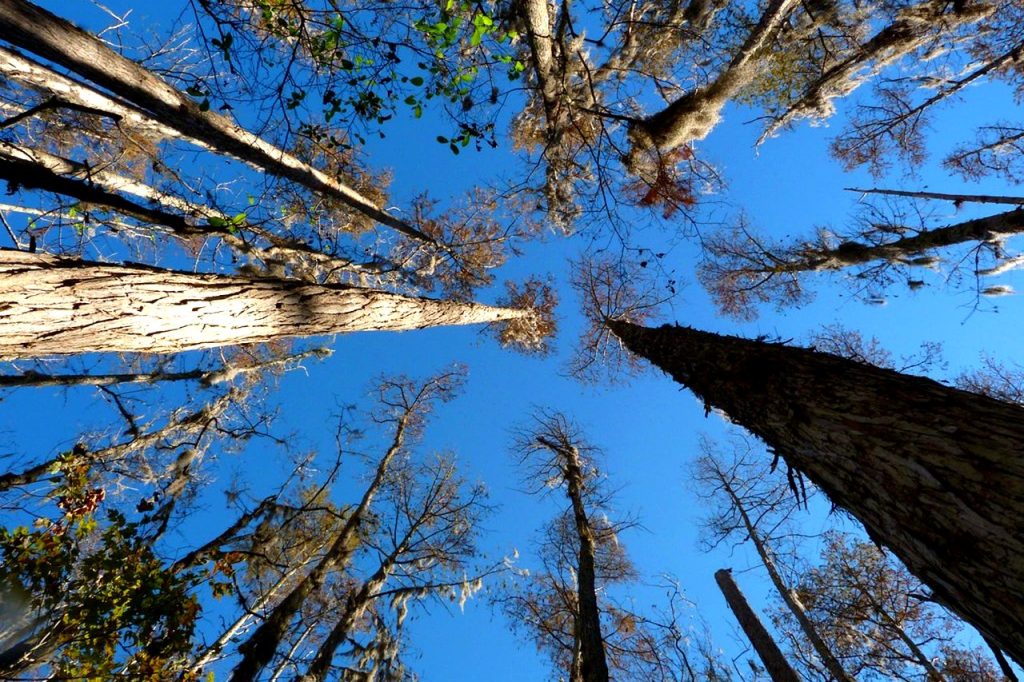
Photo: Cypress canopy on the Swamp Walk at Gatorland, just northeast of Hunter’s Creek in Southchase. Photo: Rusty Clark, CC BY, via Flickr.
Orlando Citizen by email
The weekly edition, in your inbox
One email, every Saturday: the week’s edition of Orlando Citizen — the week’s stories, rankings and winners, gathered in one place. Free, and you can unsubscribe at any time.
Related Stories

Editor’s Picks
Spotted an error? Tell us — corrections · How we rank