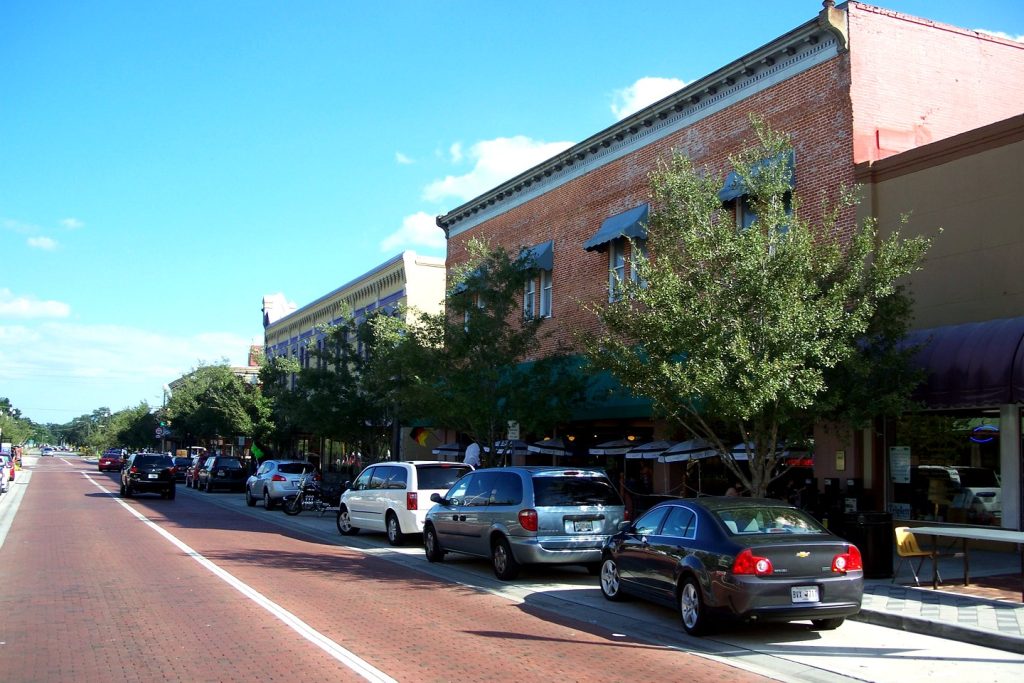
First Street: The Brick Main Street That Fire Built
Rebuilt in brick after 1887 and listed on the National Register in 1976, Sanford's First Street is a working main street of restaurants, breweries and galleries.
3 minute read
First Street is what a Florida main street looks like when a town refuses to let it die. Running east–west through the heart of Sanford, two blocks south of Lake Monroe, it is a brick-paved corridor of two- and three-storey buildings raised in the decades after an 1887 fire levelled the wooden downtown — rebuilt in brick, listed on the National Register of Historic Places in 1976, and now holding one of the densest collections of independent restaurants, breweries, galleries and shops in Central Florida.
The district, mapped in your head
The Downtown Commercial Historic District runs roughly from Fulton and Commercial Streets south to Third Street, and from Myrtle Avenue east to Sanford Avenue. Within it, First Street is the spine: Henry’s Depot food hall anchors the west end at 212 West 1st, the downtown clock marks the Magnolia Avenue crossing — the district’s informal centre — and Fort Mellon Park and the lake close the view east. One block south, Second Street carries the quieter second act: coffee roasters, eateries and the Ritz Theater on Magnolia, the 1923 theatre that operates today as the Wayne Densch Performing Arts Center. South of the commercial blocks, the Sanford Residential Historic District takes over — street after street of Victorian-era and early-20th-century houses under towering oaks, worth a deliberate detour on foot.
A street that still works
What distinguishes First Street from a preserved museum piece is that everything on it is in use. The Historic Sanford Welcome Center at 230 East 1st Street is the practical start — visitor information in the middle of the district it describes. Antique shops and galleries fill the storefronts between the restaurants. On Saturday mornings a farmers market takes over East First Street, and monthly, Alive After 5 turns the district into a street party that pulls the whole region in. The city’s own summary lists the ingredients without embellishment: brick-lined streets, elegant storefronts, and one of Central Florida’s oldest incorporated cities arranged around them.
Reading the buildings
Walk it with your eyes up. The post-fire generation built in brick with pressed-metal cornices, cast-iron storefronts and parapets dated and named — the 1922 Meisch building behind the downtown clock is the block’s signature. These were banks, hardware stores, hotels and theatres for a rail-and-river city that shipped Central Florida’s produce to the world, and the Sanford Museum, just north toward the lake, holds the paperwork: the Henry Shelton Sanford story, the railroad years, the celery era that nicknamed the town Celery City. An hour on First Street plus twenty minutes in the museum and you can read the whole town.
The streets around the street
First Street does not stand alone, and the blocks framing it repay ten spare minutes. Magnolia Avenue runs north to the Ritz Theater and on toward the lake, past Magnolia Square — the courtyard that hosts downtown’s markets and festival spillover. Sanford Avenue, the district’s eastern edge, runs south past galleries and bars to Wop’s Hops and the brewery blocks. Park Avenue and Palmetto Avenue carry the district’s quieter storefronts and its working-town services, the barbers and offices that keep downtown honest. And everywhere, the residential district presses in from the south: porch-fronted houses under the oak canopy, close enough that downtown’s waiters and shopkeepers walk to work. That interlock — living streets feeding a working main street — is the thing preservation districts usually lose. Sanford kept it.
How to walk it
Come on a Saturday if you can: market in the morning, lunch on the street, the RiverWalk — two blocks north — for the afternoon light. Or come on a weekday and have the sidewalks to yourself, coffee from Second Street in hand. Either way, park once or arrive by the free SunRail trolley, and treat First Street as the day’s base camp: everything else in our Sanford guide — the lake, the beer halls, the zoo run — radiates from these few brick blocks. Pin the district on the Top Spots Map and start walking.
Best for: architecture and history walkers, antique hunters, Saturday-morning people, and first-time visitors deciding whether Sanford is for them. It is.
Photo: Ebyabe, CC BY-SA 3.0, via Wikimedia Commons.
Orlando Citizen by email
The weekly edition, in your inbox
One email, every Saturday: the week’s edition of Orlando Citizen — the week’s stories, rankings and winners, gathered in one place. Free, and you can unsubscribe at any time.
Related Stories

Editor’s Picks
Spotted an error? Tell us — corrections · How we rank
