Walking the Brick Streets: A Field Guide to the Lake Eola Heights Historic District
487 contributing buildings, seven architectural styles and one very determined neighborhood association. How to read Orlando's first historic district — designated 1989, National Register 1992 — on foot.
3 minute read
There is a particular pleasure in walking a neighborhood that exists because its residents refused to lose it. The Lake Eola Heights Historic District — roughly 120 acres bounded by Hillcrest Street, North Hyer Avenue, Ridgewood Street and North Magnolia Avenue — holds 662 buildings, of which 487 were counted as contributing historic structures when the district was listed on the National Register of Historic Places on January 16, 1992. Three years earlier, in 1989, a petition from the neighborhood’s own historic association had made it Orlando’s first local historic district. This is the walk, and how to read what you’re looking at.
From grove to streetcar suburb
Start with the land. Citrus grower Jacob Summerlin purchased some 200 acres here in the late 19th century, when the area east of the lake was grove and pasture. The Great Freeze of 1894–95, which devastated Central Florida citrus, pushed the land toward a new use: houses. Between about 1890 and 1940, builders filled the grid with homes for the young city’s professionals and tradespeople, paving many streets in brick and planting the live oaks whose canopy now defines the district. The period of significance in the National Register nomination runs 1890 to 1940 — which is why the walk feels so coherent. Almost everything you see was built within two generations.
How to read the houses
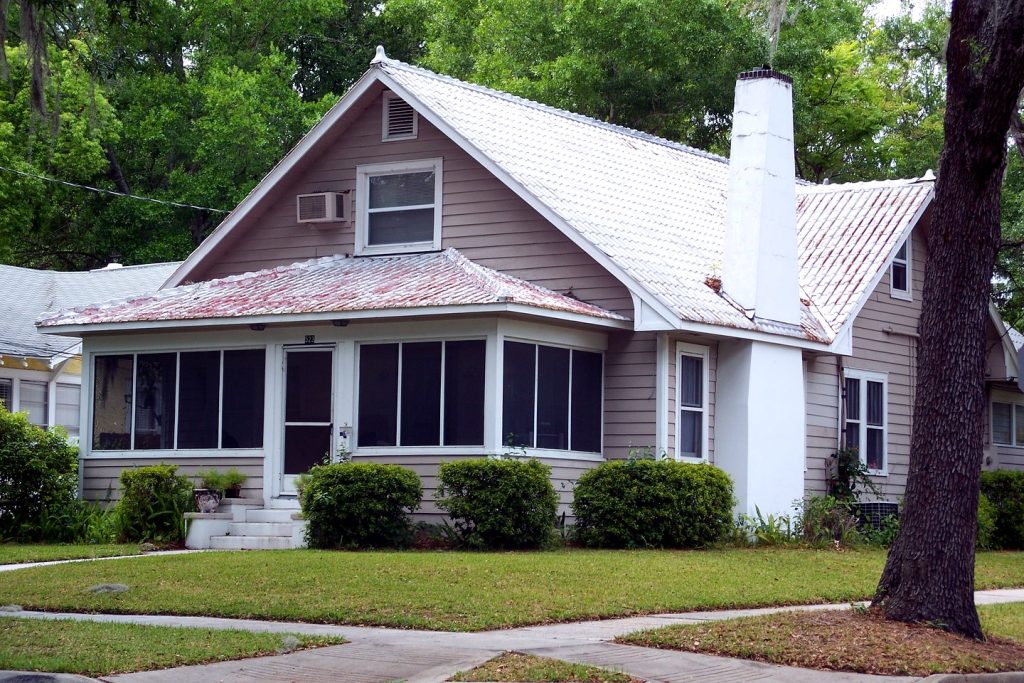
The district’s styles, per the National Register record, include Farmhouse, Colonial Revival, Craftsman, Mediterranean Revival, Mission Revival, Art Deco and Minimal Traditional — a fuller menu than most Florida neighborhoods of its size. A few field marks help. Craftsman bungalows sit low under wide, low-pitched roofs, with deep porches on tapered or brick piers and exposed rafter tails. Colonial Revival houses stand taller and more symmetrical, often with classical porch columns and multi-pane sash windows. Mediterranean Revival announces itself in stucco, red tile and arched openings — Florida’s 1920s love letter to Spain and Italy. The frame vernacular farmhouses are the oldest souls on the street: simple gabled wood houses that predate the styling wars and anchor the district’s late-1800s layer. Porches are the constant. This was a neighborhood built before air conditioning, and it shows in the best way.
The walk itself
Begin at the lake’s northeast corner and work east and north into the grid — the streets around Summerlin Avenue, Cathcart and East Livingston carry some of the densest canopy and the best variety. Brick underfoot is your confirmation you’re inside the historic fabric. Go in the morning, when the light comes sideways through the oaks and the porches are occupied by coffee rather than commuters. A unhurried loop of the core streets takes the better part of an hour; pair it with a lap of the lake and, on Sundays, the farmers market at the district’s southwest corner, and you have the neighborhood’s complete sentence. Our Lake Eola Heights guide covers the living side of the neighborhood; this walk is its archive.
House rules
Two courtesies keep the walk welcome. These are private homes — admire from the sidewalk, photograph from the street, and keep gates and lawns to their owners. And remember the district is protected, not frozen: Orlando’s historic preservation rules govern exteriors here, which is precisely why the streetscape survived to be walked. The Lake Eola Heights Historic Neighborhood Association, whose petition started all this in 1989, remains the district’s steward. End where you began, at the water — the fountain on one side, a century of porches behind you, and the whole argument for preservation made without a single plaque. For the district in context, see the neighborhood’s place on our Top Spots Map.
Photo: Ebyabe, CC BY 2.5, via Wikimedia Commons.
Orlando Citizen by email
The weekly edition, in your inbox
One email, every Saturday: the week’s edition of Orlando Citizen — the week’s stories, rankings and winners, gathered in one place. Free, and you can unsubscribe at any time.
Related Stories

Editor’s Picks
Spotted an error? Tell us — corrections · How we rank
